


29 member countries of GPAI unanimously adopts New Delhi declaration
The Minister also informed that Senegal was elevated to the steering committee during the second day of the summit, as India looks to further expand GPAI during its presidency in the coming year
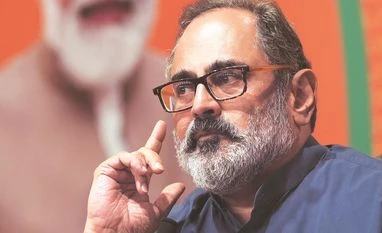 "Rajeev Chandrasekhar, Union Minister of State for Electronics and IT")
“Through a policy and legal framework, we'll restrict access to Indian data. Only trusted and safe models will get access to it,” said Rajeev Chandrasekhar Mos IT


Minister of State for Electronics and IT Rajeev Chandrashekhar on Wednesday announced the unanimous adoption of the New Delhi declaration by all the 29-member countries of the Global Partnership on Artificial Intelligence (GPAI) on the second day of the ongoing summit.
The unanimous adoption happened after a four-and-a-half hour long ministerial council meeting, 29 partner countries of the GPAI have unanimously adopted the New Delhi declaration that focuses on collaboration, inclusion and creating a governance framework on AI.
“The declaration promises to position GPAI at the front and center of shaping the future of AI in terms of both innovations, and creating collaborative AI between the partner nations to create applications of AI in healthcare, agriculture and other areas of concern,” said Chandrashekar at the media briefing in New Delhi.
Ministers and representatives of Japan, France and the UK were also present in the press conference. UK's Minister for AI and Intellectual Property Viscount Jonathan Camrose, Japan's Vice Minister in Ministry of Internal Affairs and Communications Hiroshi Yoshida and France's Minister for Digital Transition and Telecommunications Jean-Noel Barrot were present at the media briefing.
However, the details of the declaration were still not clear as it has not been shared in public.
Also Read

“We’ve also agreed today that GPAI, in keeping with the values of our partner countries, will be an inclusive partnership that will increasingly focus on including the countries of the global south and making available the benefits of the AI to everyone,” he added while talking about the inclusive nature of GPAI.
The Minister also informed that Senegal was elevated to the steering committee during the second day of the summit, as India looks to further expand GPAI during its presidency in the coming year.
“What has been agreed to is that over the next few months we will work together in GPAI to lay out some broad principles, and we can have another mid-term GPAI sitting where we can discuss those principles and targets,” he said.
The Japanese Minister, while extending support to the declaration, also announced the approval of the GPAI expert centre to be established in Tokyo. “The centre will be the first of its kind in the Asian region,” he added.
French Minister Jean Noel Barrot said that GPAI 2023 was an important summit because the members adopted the New Delhi declaration.
"In the next few months under Indian presidency of our partnership, we will be discussing as to how we can pool some of our expert resources with that of the OECD in order to extend our reach and our ability to come up with the best possible solutions for the governance and the deployment of AI for the good of our people," he added.
UK’s Minister Camrose too highlighted the importance of GPAI and said that the forum makes a strong contribution to the ecosystem of AI regulation by being inclusive and adaptive.
India to create AI computing capacity for start-ups, researchers
Meanwhile, during a panel discussion earlier in the day Chandrasekar shares that the government will by early January next year create computing capacity that private start-ups and researchers can use for artificial intelligence (AI).
The capacity will be created by the public sector and separately in collaboration with private companies. “Our aim is to create an enabling framework of AI compute capacity. We will also be creating what we think will be globally the largest and most diverse set of datasets that will be available for our research and start-up ecosystem,” said Chandrasekhar at the Global Partnership on Artificial Intelligence (GPAI) summit in Delhi.
Indian companies are working on AI but access to powerful computing capacity is limiting, he said, adding the country will restrict access to its datasets to trusted models.
“One of the things that we will end up doing through a policy framework and legal framework is restricting access to Indian data. Only those models that are trusted and are safe will get access to it. We have seen in the last four or five years that unrestricted access to data in democratic countries has been misused by certain countries…we are putting a brake on it,” he said.
In the next six to nine months, there should be an agreement among like-minded countries of the world about the basic principles around building blocks and ground rules for AI. “This process has started from Hiroshima, Bletchley, GPAI and culminates in South Korea. This is not abstract conversations...this has to be a global process and must have maximum participation. And this cannot wait — there has to be an urgency to this,” said Chandrasekhar, who was part of a panel discussion with ministers from the United Kingdom and Japan.
Focus on talent building
The minister also cautioned that in the coming years there will be a huge talent deficit and there is a need for academic institutions in India, UK, Japan to understand this and deliver the talent that the AI ecosystem will require.
“Talent is central to the group of nations strategy that we are trying to reach on AI. There needs to be joint effort among academic institutes, tech industry and the government to shape the forthcoming wave to talent in this segment,” he said during the panel discussion.
More From This Section
Don't miss the most important news and views of the day. Get them on our Telegram channel
First Published: Dec 13 2023 | 11:10 PM IST