By comparison, total electric passenger car sales in September stood at 15,247 units, while 5,538 electric cars have been registered to date in October.
Tesla reportedly received orders for about 600 cars, even though its import quota for the year was set much higher — around 2,500 vehicles. The company launched its Model Y, priced between ₹60.99 lakh and ₹75.61 lakh on-road, depending on the variant. That’s nearly double its price in key markets: The Model Y sells for roughly ₹35.3 lakh in the US and ₹32.7 lakh in China.
Analysts say this steep price differential has been a significant drag on sales.
Vietnamese automaker VinFast also entered the Indian market recently with an aggressive pricing strategy. The company began selling its VF 6 and VF 7 electric SUVs in September. It registered just six vehicles that month but appears to have gained traction in October, with 39 registrations so far.
The VF 6, a compact five-seater SUV, starts at ₹16.49 lakh, while the VF 7 is priced at ₹20.89 lakh. With these prices, VinFast is positioning itself directly against mass-market electric offerings such as the Tata Nexon EV (₹14.56–18.60 lakh) and the MG ZS EV (₹19–21 lakh).
VinFast has taken swift steps toward local manufacturing. The company recently inaugurated an EV production facility in Thoothukudi, Tamil Nadu, with an annual capacity of 50,000 units, scalable up to three times that number. Tesla, by contrast, continues to import its vehicles from China and has yet to announce any plans to assemble or manufacture in India.
In September, Tesla and VinFast accounted for less than 0.5 per cent of all EV registrations. Their combined share has edged up to 0.9 per cent so far in October.
Still, Tesla’s initial performance has outpaced Volvo, which registered only 30 electric vehicles across September and October. Volvo’s electric range, priced between ₹41 lakh and ₹59 lakh, overlaps with Tesla’s Model Y, which faces stiff competition from rivals such as BYD’s Sealion 7, Kia’s EV6, and the Volvo XC40.
For now, Tata Motors continues to dominate India’s electric passenger vehicle segment, followed by MG-JSW, Mahindra & Mahindra, BYD, and Kia Motors.


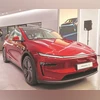 "Tesla, Tesla India")