


I want to arouse in people hope for a better future: Gulammohammed Sheikh
Sheikh on the deep wisdom the simplicity of ordinary people conceals, and the need to return to Gandhi
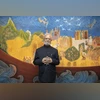 "Gulammohammed Sheikh | Photograph by Kiran Nadar Museum of Art")
premium
Gulammohammed Sheikh | Photograph by Kiran Nadar Museum of Art
7 min read Last Updated : Jan 05 2026 | 7:21 PM IST
Listen to This Article
A solo exhibition, featuring six decades of Gulammohammed Sheikh’s life in art, was inaugurated at the Durbar Hall in Ernakulam on December 13 as part of the sixth edition of the Kochi-Muziris Biennale in Kerala, which will continue till March 31. Titled “Of Worlds Within Worlds”, it is curated by Roobina Karode, director and chief curator at the Kiran Nadar Museum of Art, and features over 100 artworks, including Sheikh’s oil paintings, pen-and-ink drawings, gouaches, sculptures, poems, kaavad and accordion books, graphic prints, photographs, installations, and digital collages.
Sheikh, who was born in 1937 in Surendranagar, Gujarat, earned his Master of Fine Arts degree in painting from the Faculty of Fine Arts at the Maharaja Sayajirao University of Baroda. He later taught painting and art history at the institute.
Artist Gulammohammed Sheikh walking through the Kaavad Travelling Shrine Home at the opening of Of Worlds Within Worlds Photo credit to Kiran Nadar Museum of Art
In an interview at the unveiling in Kochi, he speaks about his works, at the heart of which is a longing for harmony – in society and within the individual. Edited excerpts:
In your work, we see a coexistence of symbols from Hinduism, Islam, Buddhism, and Christianity. What does this say about the kind of India you grew up in? What enables you to draw associations and references from multiple religious traditions?
We, in India, have the ability to live with, to respect, and accommodate multiple cultures and belief systems. And there are so many of them, apart from the ones you have mentioned. The ordinary people of India believe in several local saints, and draw strength from them. I think the soul of India lies in these simple people. When you meet them, you realise that there is deep wisdom beneath that simplicity, which never divides and always unites. I am drawn to it.
The Mappamundi Suite-7: Distant Destinations II
The 15th century weaver-poet Kabir, who is revered as a saint by Hindus, Muslims and Sikhs, and as a revolutionary by Ambedkarites and Marxists, has been a major influence on your art, especially the Kahat Kabir series. How does he speak to you?
Once I went to a Kabir yatra in Madhya Pradesh, where thousands of people had gathered to listen to his bhajans. I was stunned by the huge numbers turning up with their beddings and staying up late, not only to listen but also sing along. There was an open langar, with food for everybody. The music went on till early morning. Some were awake, others slept off.
In the morning, when I bumped into one of the men, I was curious about how followers of Kabir greet each other, pray, and worship. He said, “When we meet someone, we say Sahib Bandagi. Sahib means guru or Kabir. We remember Kabir, and bow to the divine light in the other person.”
He said that, when they pray, they have a practice of holding the palms open and placing them beside each other. It reminds them to look in the mirror of their own heart and examine themselves. Kabir always wants you to turn within because everything is right there, and it is all unified. When you refuse to look inward, and fixate on the outward, you only see divisiveness.
Horses, 1961 -62
Your words remind me of poet Walt Whitman’s book Leaves of Grass, where he writes, “I am large, I contain multitudes.” How do you retain this expansiveness when you come across a hardening of identities in our society, which makes people afraid to mingle? As an artist, how do you see your role in imagining and creating a more inclusive India?
Look at Indian history over the last 500 years, and think of how we have survived under multiple rulers. Despite the divisive forces that you are talking about, there is a feeling of openness in common people. There is a desire to connect beyond narrow identities. Looking back at my childhood, there were no Muslim boys at the school I went to. This was in the Saurashtra region of Gujarat. I grew up in the company of Jain boys, and that was not an issue. This experience of friendship, which was not tied to religion or caste, seeped into my art, too.
Speechless City, 1975
Growing up in Gujarat, you must have encountered the life and work of Mahatma Gandhi as well as the 15th century saint-poet Narsinh Mehta in an intimate way. How would you describe their influence on you as an artist and human being?
Gandhiji was, is, and will be a beacon of light forever. He said, “My life is my message.” And his life, in a sense, carried the essence of Narsinh Mehta’s teachings. Vaishnav Jana To, the bhajan that Gandhiji was so fond of, was written by Narsinh Mehta. Gandhiji’s mother, Putlibai, belonged to the Pranami sect, which takes inspiration from the Gita and the Quran. Gandhiji’s prayer meetings used to include a variety of sacred texts. Where has all this gone today? We have to return to Gandhiji because we still have so much to learn from him.
Earlier this year, artist Sudheesh Yezhuvath’s exhibition, Walk With Me, brought back memories of the months Gandhiji spent in Noakhali in 1946, trying to restore peace between Hindus and Muslims after riots broke out. It was a very sensitive time. Sudheesh retraced the route that Gandhiji took as he went from village to village and met people. Such initiatives are important because there are divisive forces even today, and we need people who are willing to fight these.
Artist Gulammohammed Sheikh addressing the opening of the show Of Worlds Within Worlds Photo credit to Kiran Nadar Museum of Art
Your entire body of work can be seen as your participation in this fight. What has been the driving force behind everything you have done and want to continue doing?
Art, for me, is an equivalent of hope. As an artist, I want to arouse in people a hope for a better future. In the poetry of Kabir, there is this idea of sangat, which is a coming together of people. If people of different faiths and belief systems meet and talk, they can get to know each other, and get rid of all their doubts and suspicions. They can develop respect for each other.
Like religion, art, too, has its gatekeepers, often using language that is so abstract that it alienates people without an academic background in art history. What do you think?
Every art from, be it painting, sculpture, music, or literature, has many facets. If you listen to certain musicians, you would be totally lost because you would find their music beyond you. You might ask, “What is he singing?” But there are other musicians who sing differently, and their music touches you. My advice is that you must not give up on the ones that you find difficult. Take the time you need. Artists are making all kinds of things. You must allow yourself to watch and listen, to ask questions. As you open your mind, it will reveal many worlds to you.
Chintan Girish Modi is a writer, journalist and art critic. Instagram/X: @chintanwriting
Topics : museum art collection Art auction exhibition