While India has robust domestic demand, Indian steel producers are seeing soft prices due to the global situation.
As and when China’s cycle picks up, and the global economy accelerates, demand could rebound. Apart from that, there’s likely to be a long period of growing domestic demand, Hence, Indian steel manufacturers have been investing in capacity expansion.
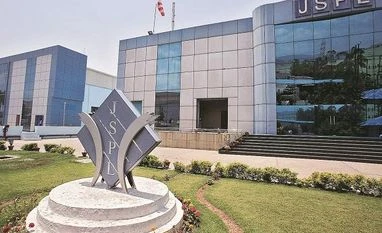
Jindal Steel and Power Ltd (JSPL) is in the forefront of this capex strategy. By FY26, its crude steel capacity will be up by 65 per cent. Alongside, JSPL plans to strengthen access to coal and iron ore, increase the share of captive power, augment flat steel production, and thus improve product mix. Importantly, given the scale and capital intensity, it has a strong balance sheet and a debt to operating profit ratio of 0.9.
The ongoing expansion at Angul (in Odisha) will enhance JSPL’s crude steel capacity by over 65 per cent to 15.9 million tonnes. This is expected to be completed by Q3FY26. JSPL recently commissioned and dispatched its first rake from the 6 million tonne hot strip mill at Angul. JSPL has two iron ore mines at Kasia (7.5 million tonnes) and Tensa (3.11 million tonnes), which fulfil 64 per cent of its iron ore requirements.
These mines are in proximity to the Barbil pellet facility, which reduces reliance on third-party miners. JSPL also has coking coal, thermal and coking coal and anthracite assets in Australia, Mozambique and South Africa, with capacities of 1.2 million tonnes, 5 million tonnes and 1.2 million tonnes, respectively.
In October 2023, JSPL started production at Gare Palma IV/6 mines, which supplies coal to its Raigarh factory. JSPL has already mined 1 million tonnes of coal in Q3FY24 and production should ramp up to over 3 million tonnes. JSPL has also commenced production at its Utkal C coal block and this should be fully commissioned in FY25. Once the doubling of Angul capacity is complete, JSPL targets an increase in Raigarh capacity to 9.6 million tonnes from 3.6 million tonnes, augmenting installed crude steel capacity to 22 million tonnes.
JSPL has guided for a capex outlay of Rs 7,500-10,000 crore per annum over the next three years. The increase in capex guidance during H1FY24 by Rs 7,000 crore to Rs 31,000 crore was mainly due to the construction of a 1.2 million tonnes cold rolling mill complex and a 0.5 million tonnes plate mill facility at Angul. After the capex, the share of flats is expected to increase to 55-58 per cent from the current 30-35 per cent. Flats command a premium over long products, and this will be margin accretive.
In FY23, JSPL acquired 2x525 megawatt (MW) power plants previously belonging to Monnet Power at Angul under IBC proceedings for Rs 410 crore. The 1,050 MW capacity will cut down on coal costs and is expected to come on stream by Q2FY25. Once fully commissioned, it will power Angul. Around Rs 3,000 crore is earmarked for completion of the power plant.
All this will result in volume growth and reduce structural costs. This is a long-term play however and much depends on not missing scheduled timelines. As and when the cycle turns around, the capex will mean better margins and stronger control of the value-chain. About 60 per cent of the analysts tracking the stock have a buy rating.


 "JSPL, Jindal, Jindal Steel and Power, Jindal Steel")

