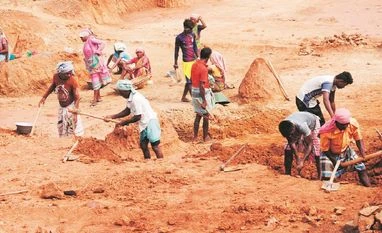
However, the Ministry of Rural Development has clarified that fixing an exact target of generating persondays cannot be accurate since the scheme is demand-driven and this financial year is just a little more than halfway through. It has also highlighted the number of persondays generated from 2006-07 to 2013-14 was only 16,600 million, whereas the corresponding number for the 2014-15 to 2024-25 period has been 29,230 million, suggesting that cumulative employment generation has been much higher over the last 10 years. Aadhaar seeding has also been done for 99.3 per cent of the active workers, helping better target-payment beneficiaries and reducing delay in payment. The data released by the Periodic Labour Force Survey shows between July-September 2023 and April-June 2024, average daily wage earnings for casual labour in rural areas increased by 7.7 per cent. This can be attributed to targeted government transfers and schemes like the MGNREGS. In 2024-25, the minimum average notified wage rate was increased by 7 per cent. Budgetary allocation for the scheme for 2024-25 is also at an all-time high of Rs 86,000 crore, a 43.3 per cent increase over last financial year. However, it is still less than the scheme’s expenditure of Rs 1.05 trillion in 2023-24. Nevertheless, since the scheme is demand-driven, allocation can always be increased later, depending on demand.
The scheme undoubtedly remains a robust welfare tool to support incomes and livelihood in rural areas. However, it should be the last option for people seeking employment. Although the demand has dropped in recent months, it remains above pre-pandemic levels. Sustained increased allocation and higher participation suggest that the economy is not creating enough gainful employment, which should worry policymakers. As has been highlighted in this space recently, the proportion of the workforce engaged in agriculture increased significantly over the past few years and has not reversed to the pre-pandemic level of 42.5 per cent (2018-19), which itself was high and reflected weaknesses in the labour market. At a broader level, while the scheme provides the much-needed safety net for rural households, the real debate should be why so many of them are falling back on it and what needs to be done to permanently reduce dependence on such schemes. The solution clearly is to create large numbers of low-skill manufacturing jobs to enable migration from the agricultural sector, something India has not been able to do over the decades.


 "MGNREGS, labour, daily wages, rural worker, rural employment")