Participating in a fireside chat with Business Standard Editorial Director Ashok Bhattacharya on the sidelines of the Samriddhi Event in Lucknow on Wednesday, the two ministers said that improved law and order, and a sense of security are the bedrock on which the state’s whole transformation in transport and tourism sectors is based upon.
Minister Dayashankar said that in UP, tenders have been issued for 1,540 new routes in which the private sector has been asked to actively participate. “We have made a special arrangement that drivers, cleaners, and conductors belong to the destination village or tehsil, so that they don’t have to travel long (to reach their homes) the next day,” he said.
UP Transport Corporation is one of the few state transport corporations in the country that has been incurring profit for the last two financial years.
“My plan is that by the time this tenure (of the government) ends in 2027, UP Transport Corporation should have ₹10,000 crore in fixed deposit, and a healthy financial situation, so that it never comes under any stress,” he said.
The transport minister said that the Corporation has set up 82 scrap centres at which 26,000 vehicles have been scrapped so far.
Dayashankar said one big change that has been made is in the way the private sector is being treated in the transport sector. “When I took charge, tenders for public private partnerships were scrapped five times, incurring a cost of over ₹85 lakh, and (there was) no participation from private players,” he said.
The transport minister said that when he held a meeting with the private players to understand their grievances, he was told that private transporters have three main problems. “First was the lease period of three years was too short, second, the rental charge of 2 per cent was too high, and third, they were not allowed to take any loans,” he said, adding that he immediately changed all that.
“I started inviting private players with a 90-year lease promise, 0.5 per cent rental, and freedom to take loans. Immediately we started getting invites from participants,” he said.
Dayashankar said when it comes to electric buses, UP has a special policy — 97 per cent of the profit goes to private operators while the state gets the balance 3 per cent. “The conductor is from the state government, which ensures strict monitoring of the routes and operations,” he said.
The transport minister said to bring down road accidents, which cause around 23,000 deaths every year in UP, the state government is planning to set up a road safety RTO (Regional Transport Office) in every district, and it has been ensured that no vehicle plies on UP roads without proper licence.
In his reply to a question on what the state has done to boost tourism, Tourism Minister Jaiveer said that the single-biggest factor behind the state registering record tourist arrivals is improved law and order.
“And you must appreciate that one job in the tourism sector generates six more jobs in other ancillary sectors that include hospitality, food, etc.,” he said.
Jaiveer said in the next two-three years, the tourism department will be the single-biggest contributor to the state’s revenues, surpassing all others. He said after capital Lucknow was recently listed in the Unesco list of Special Tourist Destinations when it comes to gastronomical delight, Sonbhadra is all set to join the list of Unesco-accredited destinations.
He said when it comes to tourism-friendly policies, the department, after studying the policies of all other states, has devised one that is extremely investor-friendly for all segments.
“So, we give a 25 per cent subsidy for setting up not only five-star hotels but even small homestays, apart from capital subsidy on land, and time-bound no-objection certificates (NOCs) to new investors, which gives a sense of welcome to them,” Jaiveer said.
He said that apart from religious tourism, which has seen exponential rise in the state due to the development of Kashi Vishwanath and Ayodhya corridors, the state government is also promoting village tourism, rural tourism, and ecotourism.


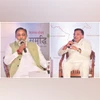 "(L-R) Dayashankar Singh, transport minister, Uttar Pradesh and the state's Tourism & Culture Minister Jaiveer Singh")