


Trump, Musk slash federal workforce as 9,500 govt employees laid off
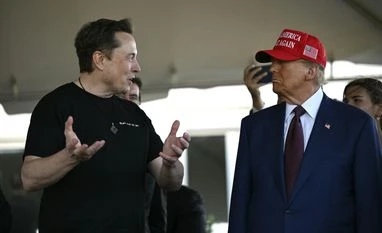
Trump and Musk have cut 9,500 federal jobs as part of their effort to reduce bureaucracy. Led by Musk's DOGE, the move has sparked political backlash, legal challenges
 "Donald Trump, Trump")
(Photo: PTI)
Listen to This Article
More than 9,500 federal workers were laid off on Friday as part of US President Donald Trump and his advisor Elon Musk’s initiative to reduce government bureaucracy. The layoffs affected employees across several key agencies, including those managing public lands, veterans' services, and health programmes.
The move is part of a broader plan to streamline the federal workforce, with Musk playing a central role in the effort through the Department of Government Efficiency (DOGE).
Layoffs impact multiple federal agencies
Workers from various government departments have been affected, including:
- Department of Interior
- Department of Energy
Also Read

 "Donald trump, Trump")
 "Illegal Indian immigrants, US military aircraft")
 "Donald Trump, Trump")
 "US Army")
 "JD Vance, Vance")
- Department of Veterans Affairs
- Department of Agriculture
- Department of Health and Human Services
Many of those let go were probationary employees in their first year, meaning they had fewer employment protections.
In addition to layoffs, some agencies have been scaled back or effectively shut down. The Consumer Financial Protection Bureau (CFPB), an independent watchdog agency, has been significantly reduced, affecting even fixed-term contract workers.
Meanwhile, the Internal Revenue Service (IRS) is preparing for further job cuts next week, according to Reuters. The timing, just before the April 15 tax deadline, has raised concerns over whether it will impact tax collection efforts.
Voluntary buyouts: 75,000 workers opt to leave
The White House confirmed that these layoffs follow an earlier buyout offer from Trump and Musk, which 75,000 federal workers accepted—amounting to about 3 per cent of the civilian workforce.
President Trump has argued that reducing the workforce is necessary due to high levels of government debt. The US currently faces $36 trillion in debt and had a $1.8 trillion deficit last year.
"The federal government is too big, and it’s time to fix it," Trump has repeatedly stated.
However, Democrats in Congress have raised concerns about the administration’s approach, saying it undermines legislative authority over government spending. Republicans, who hold the majority in both chambers, have largely supported the changes.
Elon Musk’s role in the overhaul
Musk, in his role as co-chair of DOGE, is overseeing an efficiency review of federal agencies. His team is tasked with identifying inefficiencies and restructuring government operations.
Defending Musk’s approach, US Treasury Secretary Scott Bessent compared it to a financial audit. "These are serious people. They’re going from agency to agency, doing an audit, looking for best practices," Bessent told Fox Business Network.
However, critics argue that Musk’s strategy is driven more by ideology than cost-cutting, as many of the layoffs have targeted regulatory agencies. DOGE is largely composed of engineers with little government experience, raising concerns about their understanding of public administration.
Legal challenges and scrutiny over Musk’s role
The Trump administration’s restructuring efforts have also sparked legal challenges, particularly over Musk’s role in accessing government data.
- Federal worker unions have sued to block the buyout plan.
- Three federal judges are set to review whether Musk’s team can access financial and personnel data from the Treasury Department, health agencies, and consumer protection offices.
- DOGE staffers have already gained access to records across 16 agencies, raising concerns over data privacy and oversight.
(With agency inputs)
More From This Section
 "China Taiwan")
 "Donald Trump, Trump")
 "Russia Ukraine flag, Russia-Ukraine flag")
 "Democratic Republic of Congo, DRC, DR Congo, M23, M23 rebel, Congo")
 "Trans community, Transgender")
Topics : Donald Trump Elon Musk job cut job cuts BS Web Reports
Don't miss the most important news and views of the day. Get them on our Telegram channel
First Published: Feb 15 2025 | 12:27 PM IST