Footfalls, enquiries hit speed-breaker at car dealerships, visits dip 8-10%

Slowdown began showing up in Jan, though there has been some improvement in March second half
automobile
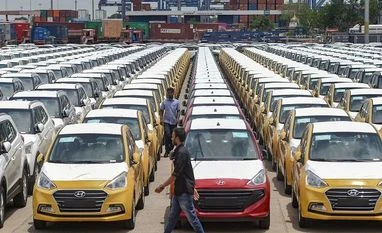
Cars are seen parked in a dock at the Chennai Port Trust | Photo: PTI
Sohini Das Mumbai
4 min read Last Updated : Mar 19 2023 | 6:59 PM IST
There are signs of a slowdown in India’s passenger vehicle (PV) market, which, at the moment, is sitting on roughly 700,000 open bookings. Dealers admit that there has been a slowdown in the footfall and fresh enquiries since January this year. Industry executives also believe that 2023-24 (FY24) will see a sharp slowdown in growth rates after volumes grow robustly in the current financial year (2022-23, or FY23).

“There has been an 8-10 per cent dip in footfall at showrooms and fresh enquiries since January this year, compared with the same period last year. There has been some improvement in the second half of March, but footfall is not back to last year’s levels,” says a South-based dealer of mass-market brands.

In addition, there is fear of cancellations as industry executives point out that several people have booked with multiple dealerships and brands in the wake of long waiting periods of popular models and supply-chain disruptions. Simply put, the open booking figures may be inflated somewhat.

Shashank Srivastava, senior executive officer-marketing and sales, Maruti Suzuki India (MSIL), agrees with the drop in footfall.

“If we take out the enquiries and booking for our new models — the Jimny and the Fronx — the bookings and enquiries are flat year-on-year. Last week, they were lower than the same period last year, weighing up retail to retail and wholesale to wholesale,” says Srivastava.

Srivastava says several factors are behind this — rise in automotive (auto) loan rates which have become more expensive by up to 250 basis points, price hikes by most manufacturers in January-February, and higher inflation.

After three price rises last year, the switch to Bharat Stage VI Phase II (BSVI-II) norms has further pushed prices, says Manish Raj Singhania, president, Federation of Automobile Dealers Associations, who feels this has impacted buyer sentiment.

“The entry-level segment is price-sensitive and gets further hit when interest rates go up. We are thus requesting the Centre to consider bringing down the effective goods and services tax rates on entry-level vehicles to 18 per cent, from the current 28 per cent, as they are a necessity, not a luxury,” Singhania tells Business Standard.

A spokesperson for Tata Motors, a company that is riding on the growing demand for sport utility vehicles (SUVs), says, “With pent-up demand, festival and wedding seasons getting over, interest rates rising, the industry may witness some moderation in demand. The demand for our popular SUVs and electric vehicles continues to remain strong with their popularity rising.”

Sukhbir Bagga, managing director, Petal Group, which runs 35 showrooms across eight auto brands — Hyundai, Jeep, Maserati, Yamaha, etc — says with news of layoffs and meltdowns across the globe, people tend to put their big-ticket purchase decisions on hold. He, however, expects the second half of March to be better, riding on year-end bookings to take advantage of depreciation; and booking ahead of the BS VI-II norms kicking in from April 1, one shells out a higher price.

However, even as the industry is hoping for a better second half of March (in terms of demand), there is consensus that March sales numbers will be lower than February’s.

“The industry volume projections are around 335,000 units — lower than the earlier expectations, and lower than February volumes,” says Srivastava.

Srivastava says it’s a ‘tale of two cities’. “On the one hand, there is a waiting period for popular models. MSIL itself has 404,000 open bookings. On the other, another set of models (mostly entry-level cars) have no waiting period, discounts on offer.”

Several people are booking multiple models with different dealerships or even different brands. They will cancel other bookings once they get a car of their choice first from one dealership. “We do not know how reliable the booking numbers are either,” adds Srivastava.

One subscription. Two world-class reads.

Already subscribed? Log in

Subscribe to read the full story →
*Subscribe to Business Standard digital and get complimentary access to The New York Times

Smart Quarterly

₹900

3 Months

₹300/Month

SAVE 25%

Smart Essential

₹2,700

1 Year

₹225/Month

SAVE 46%
*Complimentary New York Times access for the 2nd year will be given after 12 months

Super Saver

₹3,900

2 Years

₹162/Month

Subscribe

Renews automatically, cancel anytime

Here’s what’s included in our digital subscription plans

Exclusive premium stories online

  • Over 30 premium stories daily, handpicked by our editors

Complimentary Access to The New York Times

  • News, Games, Cooking, Audio, Wirecutter & The Athletic

Business Standard Epaper

  • Digital replica of our daily newspaper — with options to read, save, and share

Curated Newsletters

  • Insights on markets, finance, politics, tech, and more delivered to your inbox

Market Analysis & Investment Insights

  • In-depth market analysis & insights with access to The Smart Investor

Archives

  • Repository of articles and publications dating back to 1997

Ad-free Reading

  • Uninterrupted reading experience with no advertisements

Seamless Access Across All Devices

  • Access Business Standard across devices — mobile, tablet, or PC, via web or app

Topics :Passenger VehiclesCarsMaruti Suzuki

Next Story


