
Indian auto industry expected to see stronger growth in 2021-22: Nomura
The Indian auto industry is expected to see stronger growth in 2021-22, with electric vehicle sales also likely to see positive movements
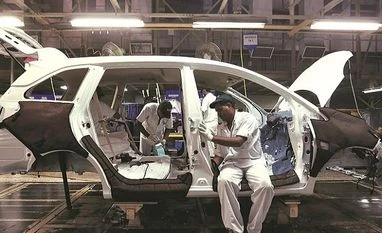 "Indian auto industry expected to see stronger growth in 2021-22: Nomura")
WebinarsNew
Deep DiveNew
Explore Business Standard
The Indian auto industry is expected to see stronger growth in 2021-22, with electric vehicle sales also likely to see positive movements
The Indian auto industry is expected to see stronger growth in 2021-22, after recovering from the devastating effects of the COVID-19 pandemic, with electric vehicle sales, especially two-wheleers, also likely to see positive movements, according to Nomura Research Institute Consulting & Solutions India.
However, in the personal vehicles segment, the levels reached in 2018-19 would be reached only in 2023-24, it added.
In 2018-19, passenger vehicle sales rose 2.7 per cent to 33,77,436 units from 32,88,581 units in 2017-18, according to the Society of Indian Automobile Manufacturers (SIAM).
"After the devastating effects of the COVID-19 pandemic, it is expected that the auto industry will see stronger growth in 2021-22," Ashim Sharma, partner and group head (business performance improvement consulting-auto, engineering and logistics) at NRI Consulting & Solutions India, said.
As far as personal vehicles are concerned, the 2018-19 levels would be reached only in 2023-24 whereas for two-wheelers, it will be achieved maybe a year after that, he added.
"In addition price hikes expected with introduction of new regulations could delay the recovery even further," Sharma said.
In 2018-19, total two-wheeler sales rose 4.86 per cent to 2,11,81,390 units as compared with 2,02,00,117 units in 2017-18.
As far as electric vehicles (EVs) are concerned, Sharma said 2021-22 would also see positive movements, especially in the two-wheeler EV segment, with new players like Ola Electric getting into the fray.
"In addition, on the EV components side, we could finally see cell level manufacturing starting off in India with technological collaborations focusing on cutting-edge technologies such as LTO (lithium titanium oxide) batteries," he said.
The LTO batteries can be fast charged at high temperatures as well as last for 10,000-plus cycles and other enhanced chemistries like NMC811, he said. NMC811 is a cathode composition with 80 per cent nickel, 10 per cent manganese and 10 per cent cobalt.
In case of other EV components such as motors and controllers, Sharma said, "We could see a wider participation by local component players and also the entry of some new players especially to cater to the rise in domestic EV two-wheeler and three-wheeler demand."
In addition, export opportunities for EV components as well as batteries could certainly emerge for domestic players as the world struggles to find alternative sources for supply chain resilience, he added.
Sharma said players that show preparedness for this can certainly capitalise on the opportunities.
(Only the headline and picture of this report may have been reworked by the Business Standard staff; the rest of the content is auto-generated from a syndicated feed.)
First Published: Dec 26 2020 | 10:26 AM IST


 Connect with us on WhatsApp