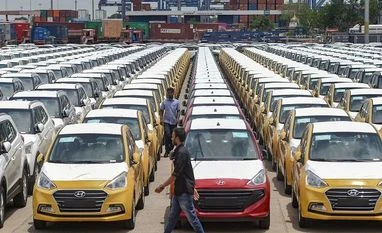
India’s export of passenger vehicles (PV), which had entered the slow lane during the pandemic but had started turning the corner last financial year, is set to pick up speed in the coming years.
With the Indian subsidiaries of global carmakers such as Maruti Suzuki and Kia Motors looking to export more, though on a low base, the sale of these PVs in markets abroad is poised to advance at a brisk pace year-on-year for the next couple of years at least. These export plans are in line with the plans of their parent companies.
The global mega electric mobility trend and the demand for fuel-efficient compact models in many emerging markets will only add heft to it, says Kavan Mukhtyar, partner and leader, Automotive-PwC India.
“The trend, however, is unlikely to be a secular one and will be dominated by a few companies and a few models in select segments,” he adds.
Puneet Gupta, director, S&P Global Mobility, agrees but cautions that “with rapid geopolitical changes and globalisation giving way to ‘regionalisation’, making in India and exporting to the world will not be easy in the medium to long term. And export destinations will get confined to select regions like Africa, Asean and South Asia.”
Also, with manufacturers aggressively pursuing zero-emission technologies, like electric, a lot of ICE (internal combustion engine) capacity is getting vacated in countries like Mexico, which used to be a feeder market for the US until a few years ago, Gupta points out.
India exported 269,069 passenger vehicle models in the first eight months of the current fiscal. This is the highest in two years for the comparable period. (see chart)
Exports offer global manufacturers a buffer from the cyclical demand swings of the domestic market. They are also a natural hedge against imports. And they prove to be a lot more lucrative than selling in the domestic market. This was one of the reasons why some PV-makers continued to export even at the peak of the semiconductor shortage amid a swelling order book and stretched waiting periods in the domestic market, says an equity analyst at a domestic brokerage.
Maruti Suzuki India, which pipped Korean rival Hyundai Motor India to become the largest PV exporter from the country in FY22, is topping the charts. The Japanese rival and domestic market leader has since stepped up exports to cement its numero-uno position.
At the end of FY22, exports as a percentage of Maruti’s total sales doubled to 14.4 per cent from 7.1 per cent in FY18. They increased to 238,376 units in FY22 compared to 126,074 units in FY18. In the first eight months of the current fiscal, Maruti’s exports have jumped to 111,229 units from 87,362 units in the same period a year ago.
Its top five export models are Baleno, Dzire, Swift, S-Presso, and Brezza. And the top export destinations include Latin America, Asean, Africa, and West Asia.
Maruti attributes the strong export run to efficiency, improvement in logistics and supply of vehicles to Toyota through Suzuki Motor Corp in the African region, which contributed to half of its total exports in FY22. It remains “cautiously optimistic”.
Hyundai Motor India, which led the exports charge for 23 of the 25 years it has been in the country, was forced to change tack because of the global semiconductor shortage. Amid the shortage, the company has been prioritising the domestic market. Though the company’s exports have grown in the first eight months of the current fiscal to 60,571 units from 54,290 units in the same period a year ago, the contribution of exports in total sales has been shrinking.
Hyundai Motor India continues to be the largest exporter of Made-in-India passenger vehicles for the world, with cumulative 3.2 million units exported to over 100 markets over the last two decades, according to a company spokesperson. In calendar year 2021, it exported cars to 80 markets, with Saudi Arabia, South Africa, Mexico, Chile, Peru, Egypt, Morocco, Tunisia, and Nepal as the key markets.
"In 2022, we have witnessed and maintained high demand across all major markets This is a significant achievement, considering the rising global uncertainties due to geo-political risks, high inflation and macro-economic adversities faced by the world markets in addition to semi-conductor shortage," says the spokesperson.
Despite these challenges, the exports have remained resilient and shown growth and the company's exports crossed the pre-pandemic levels of orders, he states.
As India’s electric-PV market matures and as more affordable cars are launched post-2025, it can open new frontiers for manufacturers.
This will be particularly helpful for home-grown firms like Tata Motors and Mahindra and Mahindra, which have the capability to bring affordable electric vehicles (EVs) to India and other markets, says S&P’s Gupta. “They can carve a niche for themselves by exporting EVs that offer a range of 500 km,” he adds.
To be sure, both Tata Motors and Mahindra and Mahindra, which have so far made limited headway in exports, have their eyes firmly set on the global markets with their EV range.
Tata Motors, for instance, is “actively considering tapping into some of the export markets beyond South Asia, for its range of EVs as it sees an opportunity of selling affordable EVs in markets outside India,” Shailesh Chandra, MD, Tata Motors PVs and Electric Mobility, had said while unveiling Curvv, an e-SUV concept, in April this year.
Globally, EVs are priced above $25,000, but Tata Motors electric models cost far less than that and can be quite disruptive. For instance, the starting price for Tata Nexon, the most expensive among the company’s range of EVs, is $18,000 (Rs 15 lakh). This is the sweet spot the company aims to target, Chandra had said.
Similarly, Mahindra and Mahindra, which has collaborated with Volkswagen for EVs, is also likely to tap into various markets where VW has a presence, says Gupta.
Clearly, the race for global markets has only just begun.