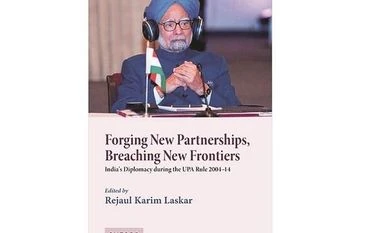
Forging New Partnerships, Breaching New Frontiers
Editor: Rejaul Karim Laskar
Publisher: Oxford University Press
At a time when prime minister Manmohan Singh’s era is fast receding from collective memory, Rejaul Karim Laskar’s book Forging New Partnerships, Breaching New Frontiers revives it. The book is a compilation of contributions by eminent writers and academics from around the world which puts the spotlight on United Progressive Alliance’s (UPA’s) diplomatic outreach from 2004 to 2014, analysing candidly its achievements and setbacks and thus filling the gap in the study of the continuum of Indian foreign policy.
The seemingly decisive shift in UPA’s foreign policy towards the US, in reality, as observed by Timothy J Lynch, was based on a neoclassical realism pursued by the leadership of the two countries diligently in their national interest. The pivot was not sudden; in fact, it was built on the National Democratic Alliance’s (NDA’s) “Next Steps in Strategic Partnership” with the US which the UPA upgraded to economic, trade, defence, counter-terrorism, intelligence, technology, etc. While the Civil Nuclear Agreement enabled India to pursue a nuclear power future, it remarkably reversed three decades of the US non-proliferation policy. One tentative but promising outcome of an emerging security order in Asia was the Quadrilateral Security Dialogue (QUAD) that was originally conceptualised by the UPA in 2007 but subsequently built by the NDA-II as a crucial pillar in the balance-of-power arrangement intended to counter a rising China.
With China, Srikanth Kondapalli observes that the UPA devised a delicate mix of competition and cooperation through the institutionalisation of communication channels. The confidence-building measures were primarily meant to minimise chances of escalation of tensions on the boundary, while bilateral partnerships with the US, Japan, Korea and ASEAN helped to blunt an assertive China. Cooperation with China was significant in G20, BRICS, BASICS and so on to promote common economic interests and thwart western pressure on climate change. India’s call for “freedom of navigation” in South China was motivated by its interest in securing the smooth passage of its trade. The fact that India’s trade deficit with China widened during this period reflects poorly on the UPA’s laxity in pursuing proactively a value-added model of domestic manufacturing.
On Pakistan, Isabelle Saint-Mezard observes that the UPA maintained quiet diplomacy through composite dialogues, back-channel diplomacy and high-level political talks on the sidelines of multilateral fora. Its inability to predict that such an approach was bound to fail exposed its naivety, especially when dealing with a country that uses cross-border terrorism as a state policy. The Mumbai terror attacks in 2008 vindicated the popular perception that complacency in such matters could prove deadly.
At a broader level Rahul Roy Chaudhary extols the UPA’s role in projecting India as a significant player in a multipolar world, away from being perceived as a peripheral actor in the Asia-Pacific region. The conclusion of as many as 15 bilateral strategic partnerships with several key countries was done with remarkable foresight. The Malabar exercises, information sharing with littoral states significantly enhanced India’s profile as a “net security provider”, a move meant to counter China’s attempt to encircle India.
John D Ciorciari commends the UPA’s farsighted “Look East” policy, which positioned India at the centre of the Indo-Pacific order. The shift towards “Connect Central Asia” was timely. India’s rise as a maritime power through the modernisation of its navy and the UPA’s endeavour to secure support of the UN members for India’s permanent membership of the United Nations Security Council (UNSC) was extensive. Former US president Barack Obama’s explicit support for a permanent seat for India on the UNSC during his visit to India in 2010 was a significant gain.
These foreign policy postulations undoubtedly raised India’s stature globally, but came at the cost of neglecting South Asia, reflecting a fundamental flaw in the UPA’s prioritisation. Managing relations with neighbours is a major touchstone of foreign policy efficiency of any country that aims to be global power, and the neglect of it could deeply dent its credibility.
Ramesh Takur observes that, contrary to popular belief, the core principle of India’s foreign policy at all times was always anchored in the Non-Alignment Movement principles. Its articulation is often captioned as “strategic autonomy”, “reformed multilateralism”, “multi-polar world” and so on, which essentially seeks to keep India’s options open and nimbly adapt to the changing situations.
The UPA’s choice of quiet diplomacy over coercion and confrontation was driven by pragmatism. The benefit of hindsight might label the UPA’s foreign policy as “status quoist”, and “over-cautious”, somewhat out of tune with the ambition of a rising power. However, analysing the compulsions of the times might allow us to better appreciate the challenges of Indian diplomacy, of having to strike a balance in a changing world that called for managing financial crisis, deglobalisation, rise of authoritarianism, including a belligerent China and yet carving out a role for itself on the global stage.

 "A closer look at 'quiet diplomacy'")












 Connect with us on WhatsApp