Babasaheb Bhimrao Ramji Ambedkar is a daunting subject for any biographer. In a relatively short lifespan — he died in 1956 at age 65 — Ambedkar accomplished much and wrote even more. There were many facets to his personality so the biographer’s challenge is to select which one to focus on: The crusader for Dalit rights, the constitutionalist, aka “Father of the Indian Constitution”, the lawyer, the economist, the historian, the bitter critic of Hinduism, the lifelong adversary of Mahatma Gandhi at whose assassination Ambedkar chose the path of conciseness in contrast to his overall wordiness (his entire oeuvre, including speeches, in Shashi Tharoor’s estimation, adds up to more than 17,500 pages), or a lifelong negotiator — with other nationalists, the British and finally members of the Constituent Assembly and later Parliament.
The second challenge for an Ambedkar biographer is the large corpus of work on him, both academic and for “general” readership. Inevitably, the biographer will be conscious of the tendency to weigh his work against earlier tomes. Thirdly, Ambedkar was an immensely polarising personality, much before this phrase became part of India’s political lexicon. There will never be a dearth of critics — and Mr Tharoor has confronted several already — who will review the book from a Dalit perspective and find liberal doses, rightly or wrongly, of upper caste presumptions. The author expressed this apprehension at the start: “I have become acutely conscious of the fact that some will object to this book on the basic ground that I am not a Dalit.” In today’s identity-driven polity, the tendency of a community to impassively “accept” a book or piece of writing only if it is written by one of their “own” has worrisome implications for social sciences as an academic discipline.
Mr Tharoor had a core divergence with Ambedkar’s stated position on an issue that remains a contentious facet of his legacy: His stance on Hinduism. At almost the mid-point of his public life, Ambedkar made the dramatic comment that while he may have been born a Hindu, he would not die as one. More than two decades later came the epochal conversion to Buddhism along with lakhs of followers in October 1956, less than two months before his death. In the decades since, Ambedkar has been appropriated by almost every party, most notably by the Bharatiya Janata Party (BJP) whose ideological fountainhead, the Rashtriya Swayamsevak Sangh and preceding party, Jana Sangh, had had sharp disagreements with Ambedkar. Even the electorally marginalised, but politically relevant force — the Indian left — is more open to Ambedkar’s efforts at making caste, especially the Untouchables (now scheduled castes), a significant marker of Indian politics.
Yet, despite posing as the true legatees of Ambedkar, the BJP mounted a vitriolic attack on a Delhi government minister and forced him to resign after realising that Arvind Kejriwal would not defend him for risking the Hindu vote. The Aam Aadmi Party politician, a representative of the scheduled castes, was targeted by BJP for participating in a mass conversion programme where the assembled followers took the same 22 vows that Ambedkar took along with an estimated million people when they converted to Buddhism. Mr Tharoor devoted adequate space in the book to the pretentious nature of Ambedkar’s appropriation by the BJP, and nailed this matter in a forthright manner.
In contrast to several Ambedkar biographies and critiques, Mr Tharoor has written a comparatively short book. He has quoted numerous social scientists and commentators for their contrasting viewpoints and because they contested Ambedkar’s positions. The chapters that squeeze in the turning points of Ambedkar’s life — the discrimination he faced, poverty he endured, personal tragedies he overcame, ill-health he suffered, yet retaining a redoubtable courage and relentless pursuit of his views and objectives — account for more than two-thirds of the book. The second part examines some of the “different” Ambedkars and is limited in structure and scope — it is a single chapter with several subchapters.

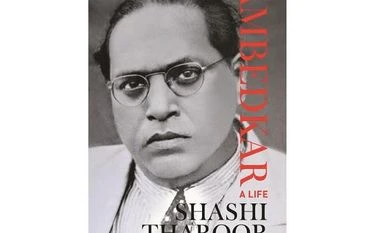 "Ambedkar in his labyrinth")












 Connect with us on WhatsApp