Mean Girl: Ayn Rand and the Culture of Greed
Lisa Duggan
University of California Press; $18.95;
116 pages
Ayn Rand liked to see herself as an ardent custodian of truth, but in her own life she had a hard time abiding too much reality. The critical recognition she craved mostly eluded her — her best-selling novels The Fountainhead (1943) and Atlas Shrugged (1957) were lurid, melodramatic, full of implausible characters and turgid harangues — and as her fame and notoriety grew, she retreated to the safe harbour of her acolytes.
Or presumably safe. As Lisa Duggan explains in Mean Girl: Ayn Rand and the Culture of Greed, when Rand’s affair with a much younger disciple soured in the late 1960s, her Objectivist movement — which venerated a single, knowable reality, rationally apprehended by gloriously self-interested individuals — seemed on the brink of collapse. “Emotion,” Ms Duggan writes, “had brought down the house of reason.”
It’s the kind of strange, glaring paradox that makes Rand a useful emblem for our topsy-turvy moment, Ms Duggan says. Rand’s simplistic reversals — selfishness is a virtue, altruism is a sin, capitalism is a deeply moral system that allows human freedom to flourish — have given her work a patina of transgression, making her beloved by those who consider themselves bold, anti-establishment truth tellers even while they cling to the prevailing hierarchical order. Not for nothing does her enormous fan base include Silicon Valley entrepreneurs, Tea Partiers, President Trump and innumerable adolescents.
But then, her ideas are too rigid to be neatly amenable to any real-world programmes. Ms Duggan’s short book includes a long section on neoliberalism that seems, for a while, to lose sight of Rand. Despite her mentorship of Alan Greenspan, who would eventually become the chairman of the Federal Reserve, Rand was “not exactly a neoliberal herself,” Ms Duggan writes. She also refused to support the election of Ronald Reagan, deriding him for succumbing to “the God, family, tradition swamp.” She was an atheist and a fierce advocate for abortion rights.
Now, almost four decades after Rand’s death in 1982, right-wing nationalism and evangelical Christianity are ascendant at the same time as economic globalisation and the erosion of the welfare state. Is there anything that ties this turbulence together? Yes, Ms Duggan says, but it isn’t the vaunted rationality that Rand fetishised as much as it is the feelings she validated. “The unifying threads are meanness and greed,” Ms Duggan writes of the current moment, “and the spirit of the whole hodgepodge is Ayn Rand.”
Rand wasn’t an especially sophisticated thinker who delved into primary texts to elaborate her philosophical system; she did, however, have a flair for the dramatic. One of her first jobs after emigrating from the Soviet Union to the United States in 1926 was as a scriptwriter for Cecil B DeMille. She brought that theatrical sensibility to novels like The Fountainhead, which, in Ms Duggan’s astute appraisal, offers “numerous plot twists but no real surprises.” In both The Fountainhead and Atlas Shrugged, “Ayn Rand made acquisitive capitalists sexy,” Ms Duggan writes. The novels “are conversion machines that run on lust.”
As befitting machines, the novels seem less literary than engineered. The Randian heroine is a Mean Girl — tall, svelte, severe. The Randian hero is a Mean Boy — tall, muscular, severe. Her villains are short and doughy, cursed with receding chins and dandruff. The undeserving weak exploit the worthy and the strong. The United States she depicts is ahistoric and sanitised for her readers’ consumption — “a clean slate for pure capitalist freedom, with no indigenous people, no slaves, no exploited immigrants or workers in sight,” Duggan writes.
Ms Duggan, a professor of social and cultural analysis at New York University and the author of previous books about gender, sexuality and cultural politics, says that her “weird obsession with Ayn Rand began many years ago.”
What seems to fascinate Ms Duggan most is how Rand — with her unyielding worldview, her extreme, sweeping statements and her intolerance of dissent — has somehow managed to be reclaimed by those she so cruelly deplored. Rand described homosexuality as “immoral” and “disgusting,” yet her “rages against the strictures of family, church and state appeal to many LGBTQ readers.” But this is what happens when you devise a philosophical system in which every human relationship is transactional: Before you know it, you’ll get co-opted and commodified too.
Ms Duggan paints Rand as cynical and shrewd in some ways, and hapless and naïve in others. In 1947, Rand volunteered to appear before the House Un-American Activities Committee as a friendly witness, delivering histrionic testimony that managed to alienate everyone, suggesting that she “never fully grasped” how Hollywood worked, or how government worked, or how the balance of power worked between the two. She liked to affect a steely, imperious persona, but she was deeply insecure and easily wounded. She developed a debilitating amphetamine habit. Her fictional heroes marched forth and conquered life, but real life kept throwing her for a loop.
Reading Ms Duggan on Rand’s current fans made me think of the 1946 preface to Rand’s early novel Anthem, in which she railed against “the people who support plans specifically designed to achieve serfdom, but hide behind the empty assertion that they are lovers of freedom.” Surveying the wreckage, such people expect “to escape moral responsibility by wailing: ‘But I didn’t mean this!’”
©2019 The New York Times News Service

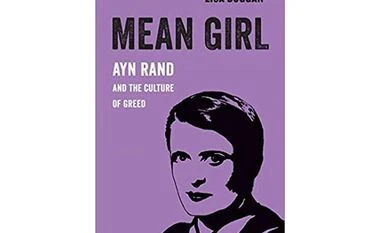 "Ayn Rand's topsy-turvy legacy")












 Connect with us on WhatsApp