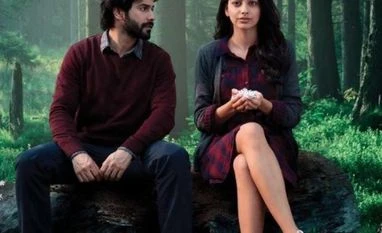
In a crucial scene in the recently released October, Varun Dhawan’s character Dan moves away from gazing at his comatose colleague, Shiuli (Banita Sandhu), after a hospital attendant shoos him away. Dan has been watching over Shiuli since a New Year’s Eve accident that left her paralysed.
This submission to authority is uncharacteristic of Dan, who — until the accident that put Shiuli in that position — is portrayed as gruff and no-nonsense. Now, however, eager to let nothing sever his fragile connection to Shiuli, he does not protest the rudeness and slinks quietly away. The film, which charts Dan’s transformation in the face of the tragedy, is a carefully wrought elegy to the power of love in the face of a challenging obstruction: an omnipresent threat of death that, while it is not realised, refuses to disappear too.
Dhawan’s performance as Dan has been critically acclaimed, and for good reason. He completely inhabits the role, an especially challenging task in a movie that is not plot-driven and relies, for its narrative arc, on the randomness of life both in the interactions of those left behind by Shiuli’s tragedy and in what ultimately transpires.
Apart from an early role in Badlapur, Dhawan has given little indication of the acting chops he so confidently displays in October. His last release before this film was Judwaa 2, an out-and-out Bollywood comedy whose first instalment was helmed by Salman Khan two decades ago. His father David Dhawan, who directed both versions of the Judwaa franchise, is most well-known for his association with Govinda in a number of salt-of-the-earth comedies.
But the dichotomy suggested by Dhawan’s choice of roles may be more imaginary than real. For instance, he has also done the Badrinath films with Alia Bhatt, and while they too are soaked in the commercial tradition, in both, he portrayed rustic men with an endearing tenderness. His ability to fully adopt the mannerisms and accent of a small-town chap is particularly impressive.
Varun Dhawan and Banita Sandhu in October
Dhawan famously stalked Shoojit Sircar, the director of October, for many months before the latter agreed to consider him for a role. Sircar is the director of such slice-of-life dramas as Vicky Donor and Piku, and in the latter film specifically, he turned out something so spectacularly modern yet rooted in Indianness that he became the go-to director for actors looking to establish their credentials.
A consistent hits-churner, Dhawan has nevertheless had to confront charges of nepotism. He, along with Saif Ali Khan, famously got into a scrap with Kangana Ranaut over the issue, but he was also quick to issue an apology when he claimed his ideas were misconstrued. Similarly, he apologised to the Mumbai traffic police over sharing a selfie with a fan in the midst of traffic. This willingness to say sorry makes him something of a pleasant aberration in an industry where stars are known to get away with far more sinister crimes.
Besides, he makes mincemeat of the nepotism debate. Yes, there is some truth to the assertion that people born to the industry, such as Dhawan and Bhatt, get easy entries and plum roles. But when one sees Dhawan in an October or Bhatt in a Highway, those considerations pale before the sheer power of their performances.
This new generation of Bollywood actors frustrate attempts to categorise them. One reason for this is the changing face of Bollywood where lines between the so-called commercial and parallel cinema are increasingly blurred. More importantly, the actors themselves are equally at home in both genres. Dhawan is as comfortable doing a dance drama (ABCD) as he is channeling his darker side in Badlapur.
It is also worth asking if this divide ever really existed. Stalwarts of the screen, including such diverse thespians as Amitabh Bachchan and Naseeruddin Shah, have always bridged this gap. This list includes even Govinda, whose versatility in emotional dramas is an acting masterclass. What has perhaps changed is the texture of films being made today, with more realism, more subtlety and definitely more muted colour palettes.
In interviews, Dhawan is self-effacing, a trait that he arguably used in his portrayal of Dan. He often speaks about philosophical themes like the curse of modernity, the transience of life, and the need to reach out to others. This can be surreal coming from a bonafide Bollywood star but for some reason, with Dhawan it seems authentic. In spite of the brashness he is commonly associated with on screen, Varun Dhawan, the man and the actor, is eminently suited to playing the sort of character that, like Dan, watches you from a distance and retreats into the shadows when confronted.