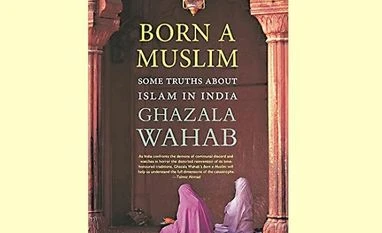
Born a Muslim: Some Truths About Islam in India
Author: Ghazala Wahab
Publisher: Aleph
Price: Rs 999
Pages: 399
The capacious and comprehensive Born a Muslim by journalist and writer Ghazala Wahab was born out of a massively ambitious aim. To quote from the book, she “wanted to represent the case of Muslims to those who wonder about them”, a necessity in the India of today, which is polarised to a deadly extent. Most Indians, though educated, conceive of Muslims in either of two ways: One, according to the poisonous, murderous canards floated by the Sangh Parivar, or, to a lesser extent, two, the sterile propaganda by successive Congress-led governments that created two-dimensional fantasy versions of Muslims that were adequately lightweight for poorly drawn wall murals in government schools. These both are not the same, as crimes go, but either version obscures the truth and prevents inter-religious dialogue based on reality. So to spread information about Islamic culture and ideas among the subtly saffronised majority of Indians is a most welcome step. The second part of the book’s aim — to also “represent Islam itself in a contemporary mould to Muslims” — is equally needed, says the author. The reason, she writes, is that many if not most Indian Muslims have fallen under the sway of an increasingly conservative ulema which have transformed a religion based on debate, reasoning and enquiry into a collection of rules, which largely smother thought with the terror of hell, and many of which prop up patriarchy and other social evils. The author wants, through the book, to open debates on the way forward for Islam. That’s a colossal mandate for any one author to take upon herself. Does she do justice to it?
Born a Muslim has all the hallmarks of nonfiction currently in vogue in India: It blends personal, memoiristic passages with the reported experiences of others, and scene-setting, travelogue-like openings with interviews and exposition. But equally importantly, because it is about a religious community, the book explains the origin of Islamic customs and rules by quoting the Quran and significant non-Quranic texts (and, in many cases, their misinterpretation by vested interests). The author quotes extensively from the hadith, which, we are told, are the recollections of Prophet Muhammad’s “conversations and comments on issues”, as well as the “memory of his actions” and interpretations of “his silent approval”; contemporary Muslims treat these as sacred, despite the apocryphal nature of several hadiths. This blend of elements and registers works very effectively, making the book a surprisingly quick read, although the book clocks in at nearly 400 pages, and despite the fact that it deals with all the pressing issues you might associate with Muslims in India.
The author emphasises the need for contemporary thinking in Islam, particularly in India, where Muslims follow caste. A whole chapter, for instance, is devoted to the status of women under Islam in India, with special reference to restrictions on their personal freedoms. We get a lot of illuminating detail about the knotty issues of Muslim personal law, such as the discrimination against women codified in rules regarding divorce and inheritance of property and other assets; and instant triple talaq is exposed as a thoroughly un-Islamic practice. Moreover, we are briefed about the four main issues on which Muslims disagree among themselves, namely, “jihad; seventy-two houris in paradise for martyrs or those who participate in jihad; consumption of alcohol; and hijab”. I won’t offer spoilers; suffice it to say that the author brings a questioning mind and thorough research to each of these questions, nuancing each admirably and upending our fossilised ideas of the “intolerance” of Islamic texts, with which, of course, we haven’t engaged at all.
The author delves briefly and breezily into the history of Islam, beginning with its founder, Prophet Muhammad. Islam’s entry into India is also covered, from its inception right up to its inclusion in Ganga-Jamni culture that many of us to this day yearn for as for a fragrant garden. Further in the book, the popular idea about “invading” Muslim rulers and their perceived “repression” of the Hindu majority is also subjected to the heat and light of fact-based enquiry, to magnificent effect.
The author busts preconceptions of a monolithic Islamic community. We are given a brisk primer to the various Islamic sects within and outside India, and their vehement, existential hatred of each other (in many cases). Bringing us into the current day, the author laments the growth of hardline Saudi-sponsored Wahhabi Islam in India, holding it responsible for massive radicalisation, consequent vilification of Islam, as well as violence stemming from terrorism. And Muslims, the author says, are “the biggest victims of violence at the hands of Muslims”.
Adding to the massive worth of the book, the author performs the unenviable task of reading the poisonous writings of Hindutva ideologues, in order to show how history was falsified and distorted to perpetuate the baseless outrage of the Hindu majority at mostly imagined persecution at the hands of Muslim “invaders”. In an even-toned section, the author delves into the history of the Rashtriya Swayamsevak Sangh and exposes its track record of engineering communal riots through the years, as well as indoctrinating Indian society through mass outreach comprising schools, colleges, labour organisations, and various political outfits including the Bharatiya Janata Party. We get moving accounts of violence against Muslims, including those surrounding the Babri Masjid demolition, such as the communal violence in Bombay in 1992-93; and the anti-Muslim pogrom in Gujarat after the Godhra incident, under the rule of then Chief Minister Narendra Modi. The author segues into the nightmarish present, in which Modi leads the nation.
Then, the author speaks of young Muslims who are assertive about their human and democratic rights. She writes, “… by their broad-brushing of all Indian Muslims as a common adversary, the Modi government has successfully united them — in their fears and resistance”. The book ends on a hopeful, soaring note.
Spectacularly, the author succeeds in fulfilling her mandate of informing non-Muslims about Islam in India and engaging Muslims in a conversation about the way forward for Islam in India. Without hesitation, I would say Born a Muslim is an essential read for the general Indian audience, and must be translated into every Indian language.

 "Book Review: Islam in India - Some reality checks and balances")











