By my carpet and sword
While Indian carpets fetch record prices in the West, they continue to languish back home
Kishore Singh New Delhi In the spring of 2009, Indians took note of one its private treasures auctioned by Sotheby's in New York for an astounding $5.5 million. The lot in question was a pearl carpet, a tapestry of rare gems and rows of pearls that the Maharaja of Baroda had commissioned in 1865, and which had disappeared some time between independence and the ceasing of the privy purse in 1971 - carried off, so rumour mills suggested, by a
maharani to the Riviera, where it was sold and remained out of view till it surfaced at the auction preview. Its current owner? The auction house won't say.
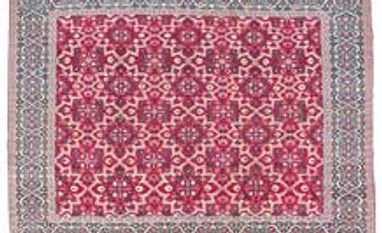
A previous record for the most expensive carpet had been $4.5 million - this one for a silk Isfahan rug - but this week's extraordinary benchmark is for another carpet, this time from Mughal India, dating to the late 17th-early 18th century, that was auctioned by Christie's in London for an astounding $7.7 million. Previously owned by American industrialist Cornelius Vanderbilt II, in whose family mansion it had apparently hung for over a century, it is one of probably a dozen
Millefleur "star lattice" carpets that date from that period.
For a country with such a distinctive carpet-weaving tradition, India has been extremely neglectful of its heritage. Old and rare carpets are rolled up and put away, prey to everything from termites to fleas and bugs. Dust eats into the pile, particularly in the cities where acidic pollutants attack the core. Even so, experts will tell you that carpets that are in use tend to have a longer life than those that have been put away. And there are few experts and even fewer restorers who can study, date, maintain, restore or advise on the care of carpets - companies such as Carper Cellar being the exception rather than the rule.
In the West, though, carpets weren't always intended for use on the floor, despite their climate: which is one reason why they've had a longevity beyond the subcontinent's cavalier attitude for these extraordinary works of art. Compared with the tapestry tradition in France, and as evidenced in the tapestry galleries in Vatican City, carpets were considered superior enough to be suspended from walls and viewed for their amazing hand skill. The Asian people might well consider this sacrilegious: a carpet, eventually, is no more than the purpose it is intended to serve - underfoot. It can be a mat for sitting or even sleeping on; and in Afghanistan,
kilims were used as nothing more than a covering that formed a comfortable saddle for donkeys, or camels. They were given as dowry - and still are - and taken to war by the Mughals and the Rajputs, to be used in the tented cities that sprung up in the dusty plains, and often abandoned there for their bloodied fate.
Italian traders were among the earliest to take a fancy to the subcontinent's carpets, and the French and British followed - which may partly be the reason why 17th century examples are still extant. The handknotted tradition has always enjoyed premium in industrialised Europe, but the increasing rarity of these works (and perhaps their commendable level of preservation) is probably responsible for these record prices. Interest in classical Indian art in any case is going through a phase of popularity. At Sotheby's auction of imperial Indian treasures in London this week, a bejeweled
paan-daan fetched as much as Rs 6.5 crore and a sword believed to have been part of Tipu Sultan's personal armoury brought in Rs 1 crore. The anonymous bid for the sword was made over the phone. Whether or not it was Vijay Mallya - the previous buyer of Tipu memorabilia, but currently broke - could be anybody's guess.

 "By my carpet and sword")


 Connect with us on WhatsApp