I saw a play on Thursday evening, called Crossing to Talikota. It was the last play written by Girish Karnad, who was a friend, and was directed by Arjun Sajnani, also a friend. The play is about a battle that is not as famous or as well known as, say, the second and third battles of Panipat. Or the battle of Plassey.
This is strange because the same themes that touch upon Panipat appear here: the domination of “foreign” rulers over Indian ones and the end of a sort of golden era, whether real or imagined.
Such a difference happens because generally speaking, North Indians control the debate of history in our country and the South is demoted. Talikota is near Bijapur in north Karnataka and the battle took place in 1565, when Akbar was the ruler in the north and, aged 23, just beginning to get into his stride. The sultans of Ahmednagar, Bijapur and Golconda gang up against the Rama Raya and defeat him, beheading the king and ransacking Hampi. And so there was a lot of passion, anger, hatred, violence and hysteria.
Now this piece is not about the history or even about the battle but about the language. You see, the play was in English, though originally written, I believe, in Kannada. Had it been in Kannada, I would not have been able to access it because my knowledge of that language is quite poor. This is shameful because I have been a resident of Kannada-speaking parts for a few years now and I really should have made an effort. It is the liberalism and generosity of the locals that has made it easy for me to get away.
They are willing to switch to a common language, such as Hindi or English, out of consideration for me even when they might not themselves speak it well. Cabbies and carpenters here will open a conversation in Kannada on the assumption that the other can speak it, meaning that in their experience most people speak it or attempt to speak it. Anyway, I am glad that the play was in English but the fact that it was in English also seemed that (to me, anyway) it felt awkward in its communication of the very strong emotions that were expressed. When an empire is lost, there is death and loss and uncertainty. All of which produce feeling among many bordering on hysteria. All of this was shown in the play. Can such powerful and visceral things be communicated by Indians in English?
Our national conversation, meaning that which relates to the economy, security, constitutionalism and the law and so on, has been appropriated by English and that is fine. The question is — why then, even among the elites, does Hindi (and our other tongues) dominate popular culture? There’s no need to spend much time proving this: any dance floor will light up when Bollywood is played and that is a fact.
This is personal and on the sample size of one but I have the same relationship with music. As a young man, I played the guitar and was with a band for several years. We sang the usual things that were played around the world in that period. But by the time I was 30, my taste in music, meaning what I enjoyed listening to, was all sub-continental or was linked to similar tastes. I liked symphonic music, frequented its concerts and was a patron of the orchestra in Mumbai. However, what I leaned on in moments when I sought emotional connect with sound was entirely Hindustani. Readers may be familiar with such a sentiment, having felt it themselves.

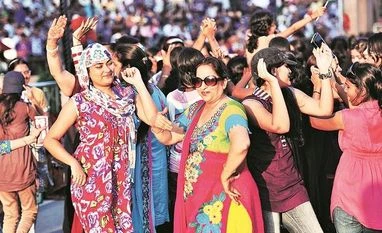 "Can we emote in English?")












 Connect with us on WhatsApp