The Grand Prix at Tbilisi is under way while the Zurich Challenge has just concluded. Evgeny Tomashevsky leads at Tbilisi with a fantastic 3.5 from 4 rounds, ahead of Alexander Grischuk, Aneesh Giri and Dmitry Jakovenko, who are all on 2.5. This is another very strong event. Of the 12-player field, only Baadur Jobava (2696) is rated below 2700. Grischuk is now the world no 2 on the live ratings and Giri is also very close to crossing the 2800 mark.
The Zurich Challenge had a very complicated format that was changed at the last minute. It was a 6-player double round robin. One round was with classical time controls, with the round played at rapid. There was double weight to the classical results.
Viswanathan Anand played good chess to win the classical round. He scored wins against Levon Aronian and Hikaru Nakamura and drew the other three against Sergey Karjakin, Fabiano Caruana and Vladimir Kramnik. After the classical, Anand led with 3.5 (+2,=3) while Nakamura had 3 points and Kramnik 2.5. Caruana, Aronian and Karjakin were all on minus scores with 2 each.
But the American GM performed brilliantly in the rapids. He beat Anand in their personal encounter and scored 4 (+3,=2) to tie overall with Anand (+1,-2,=2). Then they played an unscheduled Armageddon tiebreaker that Nakamura won handily with black.
Nakamura was hovering above the 2800 level before his classical loss to Anand. This was the first time Anand had beaten Nakamura in a classical game. The other win for Anand, against Aronian, featured a brilliant novelty involving a piece sacrifice.
Nakamura also had a fantastic win against Karjakin when he grabbed material and took his king to c4 on move 15. This has been analysed to a draw. Karjakin knew the evaluation. But he forgot the analysis and couldn't find the best moves on the board.
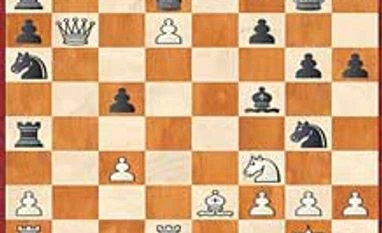
The Diagram, BLACK TO PLAY (White: Anand Vs Black: Aronian, Zurich 2015) is a prepared variation. White has sacrificed a piece for that huge passed pawn. What should black do?
Aronian tried
19...Be4!? In the post-mortem Anand demonstrat-ed computer analysis 19...Nc7! 20.h3! Nf6 21.Ne5 and 20.--Nxf2 21. Kxf2 Bxd7 22. Bb5 Nxb5 23. Rxd7 Qb8 24. Qd5 Qf8 which should be about equal.
20.Qb3 Bc6? This loses. The only move is 20...Ra5! 21.Nd2! Bxg2! 22. Nc4 Rb8 23. Qc2 Nxf2 24. Kxf2 Ba8 with chances of perpetual. Another impossible computer line.
21.Rd6! Bxd7 White had threats of Rxg6/ Rxc6. Play continued
22.Rad1 Qb8 23.Rxd7 Qxb3 24.axb3 Ra2 25.Bc4 Material equality but Black is dead-lost due to difference in activity.
25...Rf8 26.R7d6! A piece goes with threats of
Rxg6+/Rxa6 26...Kg7 27.Rxa6 Rxf2 28.Re1 (1-0).
Devangshu Datta is an internationally rated chess and correspondence chess player

 "Chess (#1136)")


 Connect with us on WhatsApp