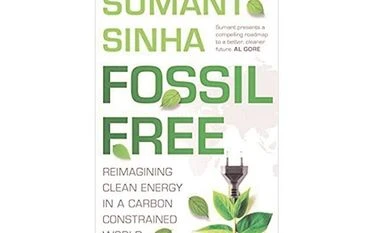
I must confess I dread it when Business Standard asks me to review a book authored by a well-known personality. And Sumant Sinha is, by all counts, one of those. He ranks at the top of the Clean Energy Who’s Who, having succeeding in making ReNew Power India’s leading and fast-growing clean energy firm after a stint at Suzlon as its chief operating officer. I wondered, is Fossil Free going to be about the author or the challenge he seeks to address?
The author’s introductory note was hugely disappointing. Even without setting out the problem, the challenges, and how to navigate them, the author dives deep into the various actions the government has taken and talks about how some great things are happening in India. The introduction lacked finesse — Covid-19 thrown in here, government action there — and read more like a crude eulogy aimed at pleasing the powers-that-be. There was no need to do that. Some good things are happening in India, and this government has pushed renewable energy through both policy and action far more aggressively than most other countries. But placed at the start of the book, it only served to increase my dread. Is this work, authored by the head of a firm highly dependent on government subsidies and contracts, aimed more at pleasing the government than taking the reader on a journey through the rapidly evolving world of renewable energy?
But I carried on nevertheless. After all, there was a lot of knowledge and experience speaking here, and it deserved a proper read for that reason alone. Thankfully the first part of the introductory chapter does not disappoint. It crisply sketches the history of energy use and the progress from animal to coal to petrol to (now) renewable. The author informs us that by the middle of this decade, renewable plus storage would be cheaper than conventional power. If that is really the case, then it’s game over for conventional power already. Unfortunately, we have to wait till a later chapter to understand this better.
Publisher: Harper Business
Mr Sinha navigates through a range of important issues, from climate change and building the consensus that it is upon us and has been caused by humans, pollution, to how humanity has been dealing with it and so on. He moves, as expected, to the great potential that renewables have to offer, and how various decisions will have a bearing on the evolution of renewable energy. Technology choice is an important one but not the only one; how humanity deals with or makes those choices, the experiences of other countries all get a mention.
The underlying structure of thought is the same: Describe the science behind the concept, show how individuals and organisations have helped shape events, and how all of it is playing out. There is no doubt ample discussion on the challenges ahead, not as a separate chapter, but on every topic. The author retains his focus on the topic but covers a very wide canvas lucidly and crisply.
Overall, this is a good read on the greatest emerging challenge of climate change, and the greatest emerging opportunity of renewable energy from an Indian perspective. My key complaint is that, somehow, the flow between different ideas is not smooth and the book seems to have been put together inorganically. I would also have appreciated a deeper and honest look at India’s experience with fossil fuels in general and coal specifically. It is true that Industry chiefs rarely take on the government publicly and while that may be the Indian business ethos, the approach does detract from this book.

 "Climate change and the transfer of power")












 Connect with us on WhatsApp