Couture, printed to perfection
The days when one will be printing high-fashion dresses in our homes are coming -but aren't quite here yet
James Tarmy When the doors open on May 5 for Manus x Machina, the Met Costume Institute's Spring exhibition, visitors will be treated to 90 otherworldly high-fashion garments, including many striking items made with 3D printing. These outfits - a layered, cross-hatched suit from Chanel's 2015-16 Autumn/Winter haute couture line, an exotic, infinitely complex polyamide top in the Dutch designer Iris Van Herpen's Spring/Summer 2010 collection-are exotic now, but viewers should get ready to see a whole lot more of them in the not-too-distant future.
Currently (as evidenced by the fact that these dresses are in a museum display), 3D-printed clothes are pretty much the exclusive purview of haute couture. But as the technology is adopted by more apparel makers, it has the potential to trickle down to the masses. When that happens, "it can be as revolutionary as the sewing machine", said Andrew Bolton, Manus x Machina's curator. "It means you can 3D print your dress to your exact measurements at home."
Couture clothes, in the traditional fashion industry definition, are "items made for you, that fit your body," Bolton explained. Usually that means the garments are expensive, rare, and difficult to obtain. But with 3D printing, this extravagance will move into any home that has a printer. "Because it has the ability to mould exactly to your measurements, it's environmentally friendly, too" Bolton said. "There's no waste, whereas there's always waste with textiles."
Before you run out to buy a Makerbot for your next cocktail dress, keep in mind that 3D printing is still very much in its early stages. Such companies as Materialise, a Belgian software company that creates the technology for 3D printing and that helped create several of the dresses in the Met show, have the capability to make virtually anything a computer can model. But wearing that 3D-printed object is a different matter. "At the beginning, they were stiff, almost like body armour," said Joris Debo, the creative director of Materialise. "Slowly there were changes to make the design more flexible."
Even now, however, 3D-printed material can't come close to a fabric like cotton, let alone Lycra. That means that at present, 3D printing's fashion moment is directed toward (nonpliable) accessories first. "What you're seeing more of is the market starting to work with accessories: hardware, jewellery, footwear, eyewear," said Debo. "That's where early adopters are going."
Both Debo and Bolton said that before we see a head-to-toe 3D-printed outfit, there could first be a trend toward hybridisation. "One area where I haven't seen much growth is the combination of 3D printing with fabric," said Bolton. "Like a structured, 3D-printed bodice, with a fabric skirt." Debo compared it to the gradual introduction of electric cars. "Everyone is talking about a new industrial revolution, but I think of it as a normal evolution," he said. "A mass production component will become a mass customised component."
And what will it take for home-printed dresses to become a reality? "To my knowledge, there are a couple of companies working on this," Debo said, pointing out that it would entail the printing of a natural fibre. "We're still pretty far off." Bolton echoes that sentiment, calling home-printing "a dream." Yet both point to Iris Van Herpen's more commercial designs as the first step. "It's a slow process of adoption," Debo said. "But of course, in the last two or three years, it's changed quite rapidly."
© Bloomberg

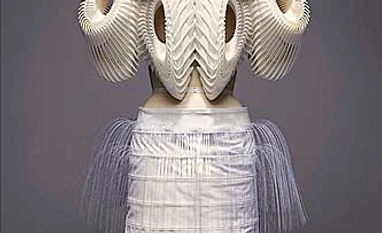 "Couture, printed to perfection")


 Connect with us on WhatsApp