I have never been much of a sailor. Heaving boats, choppy waves and the prospect of fathoms of water below neither impress nor attract me. Over the years, I’ve noted that many of my recurring nightmares involve rubber dinghies and glass-bottomed boats. And yet here I am, sailing into the sea off the Algarve coast in Portugal, to see sea caves where, as the guide says rather picturesquely, the waves sometimes churn like the insides of a washing machine. Why would one subject oneself to this, the reader might ask? Here’s why.
The famous red cliffs of the Algarve, located on the western extreme of the Iberian Peninsula in the south of Portugal, have drawn the sailor’s gaze from time immemorial. Limestone has been eroded by the sea over millennia to create a labyrinth of caves and tunnels where land meets water. Inaccessible from land, as the cliffs tower 50-odd feet over the water, these caves, with their barnacle-encrusted walls and odd oculi (holes in the roof) are a sight to behold. So, I board the reassuringly large boat at the Vilamoura marina, which is to be our home for the better part of the day.
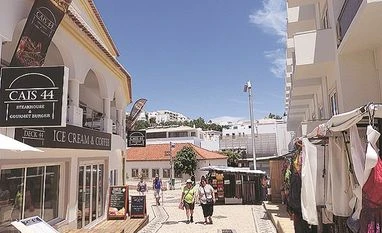
Villages along the Albufeira coast | Photos: Gaurav Sharma
Such unusual geological formations set apart the Algarve from the rest of Portugal, Joao says. Millennia of earthquake activity (it lies over an active seismic fault) and the porosity of its limestone cliffs have resulted in a landscape that’s in a constant state of flux.
A while later, our boat sails past the old town of Albufeira with its picturesque marina and beach full of sun worshipers. A parasail soars above our boat, as if keeping a flock of noisy gulls company. We come to a cliff with a largish opening at its base.
Suddenly, the sea recedes to reveal a secret beach beyond the opening! In low tide, rubber dinghies can go through that opening, Joao says. But we’re here during high tide, to my relief. However, the topography of the Algarve coast is spectacular, and I’m not even feeling sea sick. Perhaps I’ve finally found my sea legs.
You know what they say about famous last words. Soon it’s time to jump into a rubber dinghy and explore some of these caves up close. Beneath me, the sea moves like it has come to a rolling boil in a pot. We careen crazily into a dark cave, the water changing colours like a kaleidoscope — from deep blue to a jewelled emerald green. The cave smells intensely briny, somehow calming my stomach. Just when we think we’ve seen it all, we find ourselves in the spotlight cast by an oculus in the roof that lets in bright sunlight into the darkness.

 "Cruising along the Portuguese coastline")












 Connect with us on WhatsApp