August 29 marked a year since Maharashtra police arrested civil rights activist Anand Teltumbde, along with some others, for his alleged role in the Bhima Koregaon violence of January 2018, and claimed they were investigating him in a purported Maoist plot to assassinate Prime Minister Narendra Modi. He is currently on bail.
Mr Teltumbde is one of India’s foremost public intellectuals. He has spent long years in the corporate world, taught management at some of the country’s premier institutes, including the Indian Institute of Technology, Kharagpur. He has an engineering degree, another from Indian Institute of Management, Ahmedabad, and a doctorate in cybernetics.
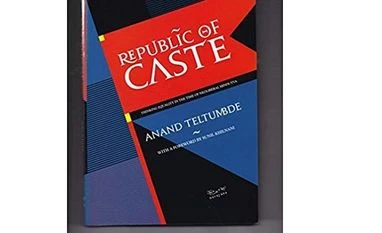
Why, therefore, would the state arrest a professor who has written books on management and on Dalit struggle and who could, at worst, be accused of committing the crime of exercising his constitutionally guaranteed right to dissent? The answer could lie in Mr Teltumbde’s book, The Republic of Caste: Thinking Equality in the Time of Neoliberal Hindutva.
Mr Teltumbde has based the book on several monthly columns he has written for the Economic and Political Weekly over the past decade. The 13 chapters look “at how inequality in India is deeply entwined with caste and religion, and how in our times, both caste and religious fundamentalism have colluded with the market to speak the language of majoritarianism”.
Mr Teltumbde challenges some of the orthodoxies of the Dalit discourse, tries to unmask the intent behind the Sangh Parivar glorifying Dalit icon BR Ambedkar and lays bare the motivations and machinations of mainstream political parties and the state when faced with dissent from the most marginalised of its citizens.
He makes a compelling argument against reservations Dalits get in the Lok Sabha and state legislatures, in education and jobs. He wonders if caste-based reservations have become a tool for upper castes to defeat B R Ambedkar’s vision of annihilation of caste. The author says Dalits have fallen prey to ruling-class propaganda that the system may have operational defects but is essentially perfect since Ambedkar designed it.
He writes that Ambedkar himself “had declared quite plainly in the Rajya Sabha in 1953 that he had been used as a hack in the writing of the Constitution”. Two years later Ambedkar had described the Constitution as a “beautiful temple occupied by demons”. Mr Teltumbde says the first statement was a “painful disclosure of truth” and the second was “a strategic retreat”.
Mr Teltumbde believes violence against Dalits is primarily a phenomenon of postcolonial India. He says Dalits living in rural areas endure the upper caste grudge against reservations and pay the price when they have hardly benefited from the mechanism. He points to the killings of Surekha Bhotmange and her children in Khairlanji in September 2007 to buttress his argument that Dalits in politics and government service tend to cater to the interests of upper castes, and that reservations help them and their families instead of the community at large.
In Khairlanji, almost the entire state machinery, from the district police chief, inspector of the local police station, to the doctor who performed the postmortem were staffed by Dalits, most of them belonging to the same sub-caste as the victims. “Not only did they remain inert, some of them made matters worse. This should make Dalits sit up and rethink the logic of representation that has been the pivot of their movement,” Mr Teltumbde writes.
He argues that many social services traditionally provided by the state, such as water supply, education, healthcare, sanitation, transport, are now increasingly in private hands, which hits the majority of the poor, necessarily Dalits, hardest. Privatisation of higher education also hurts the poorer sections the most.
Mr Teltumbde disagrees with those Dalit intellectuals who claim a free market benefits the community, that markets do not recognise caste and have boosted entrepreneurial activities among certain Dalits. He says it is empirically untrue that there has been a spurt in entrepreneurial activities among Dalits, or that whatever is observed could be attributed to these policies.
On the recent glorification of Ambedkar, the author states that for the ruling classes feigning love for Ambedkar is far easier than stopping atrocities. He says the Rashtriya Swayamsevak Sangh is “nothing but the ideological enemy of Ambedkar”, but is trying to saffronise him through “a plethora of literature fraught with pure lies and half truths about Ambedkar”. “His utter contempt for Hinduism was neutralised by projecting him as the greatest benefactor of the Hindus,” Mr Teltumbde says.
The author believes the resurrection of Mr Ambedkar in public imagination has much to do with his economic views, since he is the perfect neoliberal answer to the icon of post-independence India, the nativist Mahatma Gandhi, and is also a bulwark against communism.
“The only people who could thwart this project are his own followers, by resurrecting him as the emancipator of the downtrodden and hence on the side of the resistance to neoliberalism. But when they themselves start to promote him as the greatest free market ideologue, the coast is clear for a right-wing takeover,” he writes.
Mr Teltumbde sees hope for Dalit politics in the rise of the Bhim Army and emergence of leaders such as Jignesh Mevani of Gujarat, but cautions against the threat the Hindutva forces present to “what little good was accomplished during the last seven decades.” “Given the pace with which the forces of darkness are scaling the ramparts, to persist in believing that technicalities such as constitutional barriers will prove any hurdle to them would betray monumental naiveté,” he says.
Republic of Caste: Thinking Equality in the Time of Neoliberal Hindutva
Anand Teltumbde
Navayana, 432 pages, Rs 695