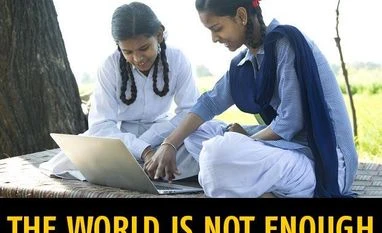
Early in this book, a young entrepreneur — who takes great pride in being from a small village in Haryana but starting a global company — tells author Snigdha Poonam: “I want to lead humanity... I want to go outside the earth... I want to lead Mars.” The statement is illustrative of how millions of young Indians now think, as self-aware citizens of the fastest-growing large economy in the world and, if the cheerleaders are to be believed, an emerging global power. These young men and women, of the same generation as this reviewer, have earned — or have been bestowed with — the licence to dream, unlike previous generations. Now, they dream of the stars, and the world is just not enough for them.
The young man who makes this interplanetary claim to Poonam is Vinay Singhal, the excitable CEO of internet media and viral content company, WittyFeed. Run out of a swanky office on the top floor of a shopping mall in Indore, the company became the 20th most-visited website this month, ahead of Twitter and Instagram. Singhal — and his co-founders Parveen Singhal and Shashank Vaishnav — are living the start-up dream, but Poonam raises important questions about the way in which this dream is sustained, and for how long. Singhal proudly displays to Poonam the corporate culture of WittyFeed — half derived from Silicon Valley and half from Indian culture, and he feels that if he can build a “$30 million company” there is nothing he can’t do.
Such a feeling is not rare among his peers, whom Poonam describes, as “the world’s largest cohort of like-minded young people, and they absolutely see no reason why the world shouldn’t run by their rules”. Of course, such aspirations will have their consequences for all of us — whether or not we wish to take part in this scrambling fight to the finish. Poonam provides some sobering statistics for as to why this enterprise could soon turn sour, making this generation, to quote the International Labour Organization, the “scarred generation”. Over the next 10 years, India needs to educate 100 million young people; for this, we need 1,000 universities and 50,000 colleges. The US has 4,200 colleges.
Even if we somehow managed to open all these institutes of higher education, there is no guarantee of the quality of training they will impart. Only “17 per cent of India’s graduates are employable,” writes Poonam, adding, “Only 2.3 per cent of the Indian workforce has undergone formal skill training.” In Japan and South Korea, it’s about 80 per cent and 96 per cent, respectively. But, with a licence to dream, everyone in India wants more opportunities, and if they are deprived of it, the result is likely to be social unrest, as we have seen in Gujarat, Maharashtra and Haryana in recent times. Reading this book, one fears the situation is likely to worsen with time. The Bharatiya Janata Party may have ridden the youth wave, and its frustrations, to power in 2014 (also the year when Poonam began researching this book), but what if it can’t keep its promises, as seems more and more likely now?
The answer can be found in the many heartbreaking stories within the covers of this book. A particularly scary one is of Arjun Kumar, a 19-year-old college student Poonam met in 2014 in Meerut. A member of the local unit of the Bajrang Dal, Kumar was waiting that day — February 14 — to get news from his superior in the violent Hindu organisation to unleash his anger on couples celebrating Valentine’s Day in the small town, often described as “riot-prone”. But what is the cause of Kumar’s anger? He is “what think pieces explaining the Trump and Brexit verdicts term a loser of globalisation,” writes Poonam. “It’s like the world swept past him while he was arranging chairs in the Bajrang Dal office.” The anger of such young men is changing the social and political landscape of this country.
Dreamers: How Young Indians Are Changing Their World; Author: Snigdha Poonam; Publisher: Penguin Viking; Pages: 271; Price: Rs 467
So are their dreams. In an interview with Scroll.in (February 3), Poonam justified the title of her book: “I was struck by how many times ‘dreams’ came up, not just what the characters in the book were dreaming about but what they thought dreams should be like.” In the book, one spoken English teacher, motivating his students in Ranchi, urges them to dream on and not be defeated: “Problems... are like a washing machine... they will turn you, beat you, wash you but finally you will come out brighter, cleaner, smarter, lighter.” This might sound trite, but Moin Khan, the teacher, had earned the right to say it: As a young man in his village who wanted to learn English, he milked cows for two months to put together the fees required to take the necessary classes.
Poonam might count herself a member of this youth cohort, coming as she did from Ranchi and becoming a successful journalist in New Delhi. She describes her own challenges in muted terms, concentrating instead on her subjects: The dreamers, “crawling out of corners like zombies in a horror movie”. By the end of the book, both the reader and the writer cover great distances, not only the one that separates swanky urban India from its dusty mofussil counterpart, but also in our perception of both. Having seen the heart of India, we can — to quote T S Eliot — remain “no longer at ease”. With a national election round the corner, this is essential reading for every thinking Indian.