5 min read Last Updated : Feb 18 2020 | 12:20 AM IST
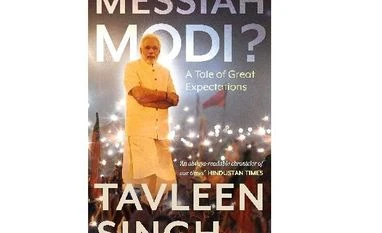
MESSIAH MODI? A Tale of Great Expectations
Author: Tavleen Singh
Publisher: HarperCollins
Price: Rs 699
When Tavleen Singh, the well-known journalist and political commentator, uses a question mark in the title of her sixth and latest book —reinforced by her choice of sub-title —she conveys a definite message.
In Messiah Modi? — part memoir and part critique of the present political dispensation — Ms Singh confesses that she started by being a “Modi bhakt” when the man who was anointed the Bharatiya Janata Party’s prime ministerial candidate began his election campaign in 2014, charmed by his promises of parivartan and vikas. Ms Singh, who takes pride in describing herself as a reporter with her ear to the ground, recounts having seen the most horrific scenes of deprivation during her travels in India’s interiors, and writes that more of the same policies by “The Dynasty” (for whom she reserves all her scorn and venom) would have got India nowhere. And so she believed Narendra Modi wholeheartedly when he promised real change, development, and prosperity for all, rather than a mere removal of poverty.
But disillusionment set in in a matter of months — in fact, as early as January 2015, when Mr Modi’s pinstriped suit became the talk of the Lutyens’ elite, because this was no mere ordinary suit, but one where the pinstripes vertically spelt out the prime minister’s full name. The following year came the disruption caused by demonetisation and the year after, hasty implementation of a flawed goods and services tax. In the meantime, in April 2017, the lynching of Muslims had begun, and the prime minister failed to condemn them until a year later. This was the defining moment when Ms Singh seriously began questioning her support for Mr Modi.
Herself a product of a privileged upbringing, she said she had come to abhor the elite of Lutyens’ Delhi — the so-called “Khan Market gang” — and its entitled ways. So, she welcomed the advent of a prime minister who was neither high-born nor well educated, and represented a definite break with the Nehruvian political culture that even Atal Bihari Vajpayee, the BJP’s first-ever prime minister, had made no effort to change. She confesses to being shocked that one jibe from Rahul Gandhi (“suit-boot ki sarkar”) was all it took for the prime minister to take refuge in the statist, populist policies of the lady who is widely believed to have remote-controlled the two governments of Manmohan Singh.
Messiah Modi? is not a straightforward linear narrative. Each chapter goes back and forth in time, describing the author’s varied experiences over a journalistic career that began during Indira Gandhi’s Emergency, when she was a cub reporter with The Statesman. The digressions are like flashbacks used by a movie director to tell his story. The chapter titled “The Suit”, for example, dwells not just on the ripples created by that infamous garment, but also on Mr Modi’s early life (and how he lived for a while in a small room behind the BJP’s office, then located at 11, Ashoka Road in New Delhi); the hazards of trying to outwit the censor during the Emergency; and an account of an interview Ms Singh had done with Mr Modi soon after he had won his third term as Gujarat chief minister, from which she came away convinced that he was totally dedicated to transforming India and its “corrupt, elitist political culture”.
She argues that Mr Modi could easily have responded to Mr Gandhi’s jibe “by throwing it right back in Rahul Gandhi’s face by saying something like, ‘I dream of an India in which every Indian will be able to afford suits and boots.’ Instead, his confidence seemed to crumble completely. The whole mood of the government changed.” Ms Singh asks herself whether Mr Modi had always intended to be as statist as the Congress. The chapter ends with the American economist Lawrence Summers telling her, at a gathering at the home of Nirmala Sitharaman, then commerce minister, that “[Mr] Modi is not a liberaliser. He is a reformer.”
Ms Singh looks back in anger, in language that is bold and provocative, liberally using intriguing quotes which, alas, are anonymous and therefore have less impact. She is outraged at Mr Modi’s marked focus on the BJP’s social, cultural and political agenda, to the virtual exclusion of real economic reform, at what she considers to be the prime minister’s failure to bring about a change in India’s political culture — and the controversial revocation of her son Aatish Taseer’s Overseas Citizen of India status. However, she gives him full credit for providing cooking gas connections and electricity to rural households, for the Swachh Bharat Abhiyan, and for keeping his government free of scandal.
Ms Singh’s disappointment is in direct proportion to the enthusiasm with which she had welcomed Mr Modi’s election in 2014. Clearly, she had attributed such nobility of intention to Mr Modi that disappointment was bound to follow. How a journalist of her standing could suspend disbelief and accept at face value promises made during an election campaign is a question that the author attempts to answer in the epilogue — but it is not particularly convincing.