4 min read Last Updated : Jan 07 2021 | 1:33 AM IST
By October 2018, the Badarpur thermal power plant next to Delhi was closed. In a study, the Centre for Science and Environment had measured the plant as responsible for up to 40 per cent of the city's particulate matter pollution from the energy sector. Yet, reporting on Delhi’s air pollution in November 2019, Time magazine described pollution levels as “off the chart”. So, what gives?
Jyoti Pande Lavakare in her book Breathing Here is Injurious to Your Health enters this complex territory. Ever since Andrei Tarkovsky’s film Stalker where the protagonists enter the Zone, a beautiful yet toxic region, where the presence of the seemingly ordinary only serves to accentuate the terror of finding a way through it, climate literature has, consciously or unconsciously, replicated the parables from that masterpiece, juxtaposing the unfolding catastrophe within our apparently ordinary existence. In fact, the 1979 classic has remained a template of sorts for subsequent forays into the climate question, whether it is Blade Runner from Hollywood or the recent Carbon Diaries.
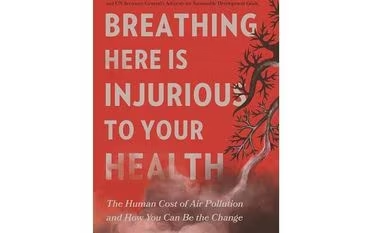
This book, too, presents the climate crisis as an uncomfortable reality, and the author deliberately does little to make the process of reading any less comfortable. She pushes readers to consider how many times they have gone through the ritual of discussing rising pollution, only to resign themselves to letting the issue fester. The author continually brings the reader face to face with the harsh reality of the situation in ways that do not allow for easy disengagement from the conversation.
That said, the sense of urgency and anxiety that grips every page of the book gives readers little time to process fully all the facts being thrown at them. By the end of the book you are exhausted, which is rather counterproductive to the cause that the author is championing.
Breathing Here is Injurious to Your Health
Author: Jyoti Pande Lavakare
Publisher: Hachette India
Pages: 326; Price: Rs 399
This is the exhaustion with which one has become quite familiar over the past year with the barrage of bad news. The timing of the book, thus, cannot be ignored since it only serves to compound this fatigue. The book ends with a sort of call to arms with various links to resources and organisations and I feel readers would be more likely to pay heed to them if they weren’t feeling so utterly overwhelmed by the book.
Still, by personalising the impact of this crisis, the author’s message is a potent one. Her feeling of helplessness as she dealt with her mother’s lung cancer hits close to home. “It is twilight now, tranquil, mystical. But when I look outside, the once bewitching evening haze looks ominous, still. Looking at the swaying crop fields outside, I recall an article on crop stubble burning that my mother’s attending pulmonologist had written in Hindi for a digital magazine. He was one of the first to tell me, almost casually, that her lung cancer was most likely caused by the polluted air she had been breathing for so many years,” she writes.
Now that Punjab’s farmers have almost extracted from the government the dual promise to allow them to continue to sow a paddy variety ridden with high silica content and therefore useless as animal fodder and so engage in more stubble burning without any prosecution, it seems as though the author, despite her intensity, may already be fighting a losing cause.
One suspects few media outlets will want to take sides on the pollution battle over Delhi when most have already made up their mind about the “wronged” farmer. It is this complexity with which literature on climate policies have to reckon.
That Delhi and north India have a massive pollution problem is undeniable. The medical emergency is also so real. Yet several constituencies, responsible for both crises are also able to cash out of their responsibility by playing the political game of checks and balances.
Only Acts of God such as the Covid-19 pandemic, it appears, can deliver clean air to the city. Despite being pilloried as a metaphor for trouble, 2020 will paradoxically remain the year with the highest number of clean air days for several years to come. As traffic, stubble and dust return to the city, the author’s call to resume the good fight, thus, seems to have already slipped beyond the imminent.




