Kunwar Viyogi, then a serving Indian Air Force officer, receiving the Sahitya Akademi Award in 1980 for his Dogri poem, Ghar. Seen in background is Krishna Sobti
Kunwar Viyogi died in 2015. Last year, on September 4, his birth anniversary, Jamwal launched the Kunwar Viyogi Memorial Trust to promote through the medium of art, culture, education and innovation the language her father was so passionate about.
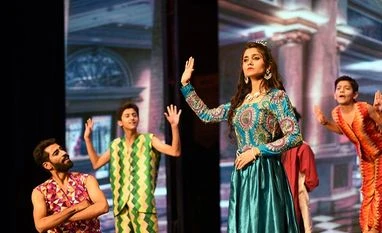
Last Saturday, as part of its “Save the Language” campaign, the trust organised a cultural festival at Kingdom of Dreams, Gurugram, which included a kathak adaptation of Kunwar Viyogi’s poem, Ghar. The festival will next travel to Chandigarh, Shimla and Kangra before the grand finale at Jammu. The aim is to popularise the language both within and outside of the state.
Three scholarships — for male and female toppers in MA Dogri and for research work on Dogri writers and poets — have also been instituted in association with Jammu university’s Dogri department. An award for the first, or best, book in Dogri too has been announced along with the Dogri Sanstha, as has an artist innovation award.
A technology tool to translate to and from the language is also on Jamwal’s mind. But the biggest challenge of all is getting the state to introduce Dogri language at primary school level.
Curiously, Dogri education has followed a top-down approach. “The language was first introduced at the postgraduate level and later in colleges,” says Magotra. It was only this week, on June 19, that in a landmark decision, the Jammu & Kashmir government made Dogri, Kashmiri and Bodhi compulsory for classes IX and X in all government-run and recognised private schools in areas where these languages are spoken as the mother tongue.
“While this is a crucial step in the right direction, if the language is to thrive and grow, it has to be taught at primary school level,” says Sahitya Akademi award-winning Dogri author Chhatrapal, whose real name is Joginder Pal Saraf but who prefers to go by his penname. A decision to the effect was taken a few years ago and the syllabus was also prepared, but that is where it remains.
The politics of the state of Jammu & Kashmir has also taken a toll on Dogri. “We have a Kashmir-centric government,” says Chhatrapal, so Dogri, the language of Jammu, doesn’t get much attention. “Dogri is not even the official language of the state, so much so that to speak in Dogri in the legislative assembly, an MLA has to seek the speaker’s permission.” On his part, Chhatrapal often pretends not to understand any other language but for Dogri when speaking with youngsters in the state. “That leaves them with no choice but to try and speak with me in Dogri,” he laughs.
The lost scripts
Written in Devanagri today, Dogri once had its own script that bore close resemblance to the now almost extinct Takri (or Tankri) script, which was used widely till the 19th century and was the language of the royal courts in the pre-independence era. Its alphabets resembled the Gurmukhi script (in which Punjabi is written).

 "For the love of Dogri, a language that is losing ground")












 Connect with us on WhatsApp