How to succeed

The authors, two blood brothers six years apart, are alumni of IIT
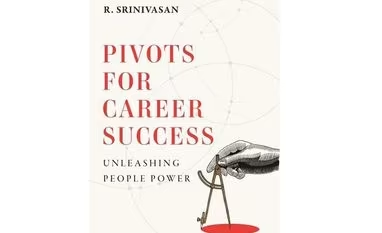
Book Cover
Pivots for Career Success: Unleashing People Power
Steve Correa
5 min read Last Updated : Mar 09 2022 | 10:34 PM IST
Pivots for Career Success: Unleashing People Power
Author: R Gopalakrishnan, R Srinivasan
Publisher: Rupa
Pages: 201
Price: Rs 500

The authors of Pivots for Career Success reflect that every lesson in life appears to be obvious when you are in your late sixties. These lessons, however, may not be obvious to those who wish to climb the “greasy pole”. Among those lessons, people relations are the most challenging. Unlike economics, finance, marketing and sales, which can be taught, the art of people relations is learnt day-by-day with experience on the job. As Aldous Huxley wrote, “Experience is what you do with whatever happens to you”.

The authors, two blood brothers six years apart, are alumni of IIT. Each has reached the dizzy heights of corporate achievement and are deeply respected. They present in this book, divided into three sections, independent and compelling narratives of a cornucopia of experiences centred on one elementary truth: “It is very difficult to judge oneself, the other and the context”.

In section 1, titled “Understanding Self”, the authors underline the basic truth about staying healthy, fit and safe. As they write, “How would you take care of your car if you were told that it would be the only car you would have for the rest of your life?” The authors ask that you enjoy what you do and do what you enjoy. The key to achieving this is following your passion. One can choose a particular stream in life and explore others later. Passion, say the authors, is a surrogate for persistence and determination, and neither talent nor genius can take its place.

One of the authors shared a story on how advice from an older executive about getting a professional degree proved a turning point for him. The lesson here is to listen to elders, reflect, then take your own decision. The authors advocate the quality of Zorba — a man needs a little madness. The authors also offer several anecdotes to reinforce the benefits of doing things properly: “One should not fear losing, but one should fear not doing things properly”. In addition to functional competence, stand firm with certain principles whatever the consequences.

In Section 2, “Understanding Others”, the authors argue that managers are trained to be rational and to shun emotions, which is not always the best approach. They point out that listening to emotion-laden stories is invaluable learning. Leadership is about doing the right thing at the right time. In this, courage is the iron ladder on which all other attributes (intelligence, compassion, determination) sit. Addressing controversial issues requires courage.
Feedback, too, is a valuable tool, but while all managers claim they want frank and open feedback, most are unprepared for it. The authors also say it is okay to “disagree, but don’t be disagreeable” and they provide ample business anecdotes to illustrate the point. Also, they advise, be prepared to do what you ask your team to do. It is a common trap to overestimate our strengths and underestimate our weaknesses. A leader, they argue, must be wise, not just bright, and intelligent.

In section 3, “Understanding the Context”, the authors weigh the choice between going in the right direction versus going far. The purpose of a career is to utilise your potential fully because that alone can give you satisfaction and self-esteem. During a crisis, a leader is expected to rally people around the task. Diving deep into the Nirma crisis (when the product famously sold for a third of the price of Surf) they offer lessons on how to act in a crisis. The controversy at ITC caused by the violation of the Foreign Exchange Regulation Act triggered a series of events that illustrate how crisis can hit you like a tidal wave and leave you struggling to catch your breath. The leader needs to see things at close range, mid-range and far into the distance.

Habits, the authors point out, are key to success. You succeed by doing things right on a regular basis. Organisations need steady-state energy and bursts of concentrated energy to get things done, and managers must have the stamina to keep alternating. Always do the right thing by one’s career: Stretch and do your best and leave the results to turn out the way they will. They stress the virtues of incremental learning.

Management is a performing art, the authors conclude. There will always be a need for capable managers to constantly traverse perspectives at different heights and recalibrate what needs to be done at the right time intervals to ensure best results.

Given my association with HUL, I could savour the many anecdotes and examples in the book. When I finished reading it, I asked myself whether I had learnt anything new. Analytics can be taught, but intuition is acquired, and that becomes a key differentiator. This book is a masterclass for all prospective leaders. It is a gift to help you navigate or pivot your way to career success. The two authors exemplify the notion of “Die Empty” (Todd Henry) — to unleash your best work every day.

The reviewer has over three decades of corporate experience across industries in India and abroad. He is currently an executive coach & HR consultant and author of The Indian Boss at Work: Thinking Global, Acting Indian. http://stevecorrea.co

One subscription. Two world-class reads.

Already subscribed? Log in

Subscribe to read the full story →
*Subscribe to Business Standard digital and get complimentary access to The New York Times

Smart Quarterly

₹900

3 Months

₹300/Month

SAVE 25%

Smart Essential

₹2,700

1 Year

₹225/Month

SAVE 46%
*Complimentary New York Times access for the 2nd year will be given after 12 months

Super Saver

₹3,900

2 Years

₹162/Month

Subscribe

Renews automatically, cancel anytime

Here’s what’s included in our digital subscription plans

Exclusive premium stories online

  • Over 30 premium stories daily, handpicked by our editors

Complimentary Access to The New York Times

  • News, Games, Cooking, Audio, Wirecutter & The Athletic

Business Standard Epaper

  • Digital replica of our daily newspaper — with options to read, save, and share

Curated Newsletters

  • Insights on markets, finance, politics, tech, and more delivered to your inbox

Market Analysis & Investment Insights

  • In-depth market analysis & insights with access to The Smart Investor

Archives

  • Repository of articles and publications dating back to 1997

Ad-free Reading

  • Uninterrupted reading experience with no advertisements

Seamless Access Across All Devices

  • Access Business Standard across devices — mobile, tablet, or PC, via web or app

Topics :BOOK REVIEWLiterature

Next Story



