Our data collection methods have been skewed because over time, men have come to be considered as the default while the female gender has rarely been taken into account
premium
Ms Criado-Pérez suggests that perhaps the data bias is so subtle that it is invisible most of the times, even to women
5 min read Last Updated : May 13 2020 | 12:51 AM IST
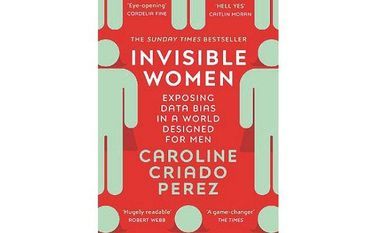
In 1949, Simone de Beauvoir wrote, “humanity is male and man defines woman not in herself, but as relative to him; she is not regarded as an autonomous being. He is the Subject, he is the Absolute — she is the Other.” Caroline Criado-Pérez’ new book Invisible Women: Data Bias in a World Designed for Men argues that little has changed in these past 70 years. Our data collection methods have been skewed because over time, men have come to be considered as the default while the female gender has rarely been taken into account. Consequently, every aspect of the human experience has been designed for men, not women. The question that readers might ask is how women continue to live, some even thrive in a world built on male data?
Ms Criado-Pérez suggests that perhaps the data bias is so subtle that it is invisible most of the times, even to women. Throughout the 400-odd pages of her book (yes, it is that long!), she renders visible many of these biases — at home, in school, in the workplace and even in the loo. Readers will learn why women often feel ill at ease in certain workplaces (they could have temperatures set low per male needs, glass staircases that allow anyone below to see up a skirt, glass doors too heavy for the average woman to open with ease and more).
It all, like things tend to do, begins at home. Ms Criado-Pérez writes that globally, 75 per cent of unpaid work is done by women who spend between three and six hours per day on it compared to men’s average of 30 minutes to two hours. She references data and anecdotal evidence from across the world and this makes for interesting reading. Readers will learn, for example, that in Uganda, a World Bank study found that after spending nearly 15 hours on a combination of housework, childcare, digging, preparing food, collecting fuel and water, women are left with merely 30 minutes of leisure time per day. By contrast, men there enjoy four hours a day of leisure. Readers will also learn that in India, five out of women’s six daily hours of unpaid labour are spent on housework, compared to men’s 13 minutes!
Some gender bias is internalised in school. A 2017 analysis of ten introductory political-science textbooks in the US found that an average of only 10.8 per cent of pages per text referenced women (some texts were as low as 5.3 per cent). Ms Criado-Pérez writes that the same level of male bias has been found in recent analyses of Armenian, Malawian, Pakistani, Taiwanese, South African and Russian textbooks. The workplace is riddled with more invisible biases. When one works till late, it is considered legitimate to charge the company for takeout, but not for extra babysitting expenses. The assumption, the author writes, is that the employee has a wife at home taking care of the kids. The long work hours culture also makes it harder for women employees to rise in the office hierarchy — for unlike most men, they are not unencumbered workers. Public spaces, including refugee and disaster relief camps across the world seem as if they are designed by men, for men. Women across the world and especially in the global South, feel they can’t hold certain jobs or go to school, because there is no toilet access. Men, on the other hand, have significantly more toilets to access and even if they are forced to use the outdoors, they don’t run the risk of sexual harassment that women do.
However, when planners do take women into account, the results are often startling. The author writes that in the mid-1990s, local officials in Vienna found that beyond the age of 10, girls didn’t play in the parks as much as boys. They collected data and it turned out that a large open space compelled girls to compete for space with boys. Because some of them lacked confidence, they stopped playing in the park. So they redesigned parks by creating subdivisions, smaller more approachable areas. Instantly, the female drop-off was reversed.
This is where the practical utility of this book lies. It is peppered with best- and worst-case examples from across the world that governments, institutions and individuals can benefit from. It also must be lauded for raising issues simply not raised often enough, even though the unpaid work that women do is the invisible cornerstone of every economy. However, its length and sheer number of examples from across the world detract from the reading experience. Interesting as it is, anecdotal evidence from different countries gives the book a somewhat fragmented feel. Instead, perhaps the book would have benefitted from complete case studies contrasting, for example, the best practices from Austria with the biases displayed in the relocation of Rio’s favelas. There is simply too much to read, and as a female reviewer with a ton of (unpaid and invisible) housework to do during the current lockdown, Invisible Women feels like it is taking way too long to make its point. As Ms Criado-Pérez goes on to elaborate upon the economic and public health benefits of tweaking systems, policies and infrastructure to take the woman’s perspective into account, one can’t help but think that all this important and exhaustive research would have been better served in not one, but perhaps two books.




