Magnified miniatures
Flat gold and 'human-like' deities lend Heerina Misra's Mysore paintings a fresh twist
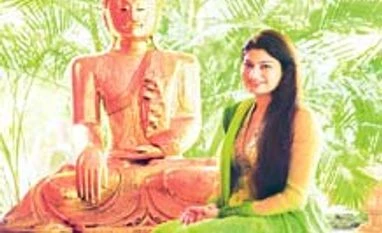
Avantika Bhuyan Red ochre dominates this painting of the Panchamukhi Ganesha, accompanied by a Sanskrit shloka extolling the virtues of the deity. The colours are typical of a traditional Mysore painting. It's the interpretation, however, that is different. Heerina Misra, in her latest exhibition "Faith 2013", has tried to present a contemporary version of the age-old Mysore school of painting. While most traditional Mysore works are miniatures with delicate lines, elaborately detailed faces and intricate gesso work, Misra's creations span a large canvas, sometimes as big as 6 feet as is evident in the painting of Mata Rani.
Misra's fascination with the Mysore school started when she wanted an artwork from the genre for her house. With an inclination for fine arts since childhood, she decided to learn the technique of Tanjore and Mysore painting in 2000. She sent her first painting to Tata Memorial Hospital in 2009 in gratitude for the near miracle doctors there worked by saving her mother's life from Stage III cancer. A lot of people who saw the artwork at the breast cancer wing called up Misra to commission a piece. Since her first exhibition in 2011, she has made 40 paintings for friends and family.
While the traditional Mysore works make use of vegetable dyes and natural colours, Misra decided to use watercolours for her early works. "I would seal the colours with ink. But after my first exhibition I started using acrylics." Instead of the 24-carat gold leaf used by the masters of Mysore, Misra has used flat gold. "If I started doing gesso work with gold leaf on such large canvases, it will take me years to finish a painting," she laughs. This classical form of art from southern India was characterised by the use of cloth as a base; artists were also known to create frescoes on the walls. Misra, however, has used archival paper which is pasted on a board. In order to prevent the curling of paper, she gets the pasting and binding done at industrial presses.
The Mysore school of art flourished under the patronage of Mummadi Krishnaraja Wodeyar, with pictorial manuscripts such as the Sritattvanidhi depicting the pantheon of gods and goddesses having been prepared in that period. The deity, be it Krishna - a favourite - or Saraswati, is typically shown exuding benevolence and divinity. Misra's paintings, on the other hand, have deities who are more "human-like" in their depiction. She has created 12 such paintings, priced Rs 3-5 lakh, specially for the exhibition. "When you are doing commissioned work, you have to create artwork according to the specifications. I wanted to experience artistic freedom with this exhibition, be it in the depiction of Ram-Sita or the treatment of Ganesha," she says. "For instance, whenever you worship Lord Ganesha, the elders tell you about mantras and shlokas related to him. You tend to forget if you don't write them down. So, I thought why not have the shloka on the painting itself."
Given the level of detailing and the size of paper used, Misra has had to put in nearly 150 hours of work on each painting. "It can go up to 250 hours as well," she says.
Faith 2013 will be open for viewing till October 24 at the Australian High Commission, New Delhi

 "Magnified miniatures")


 Connect with us on WhatsApp