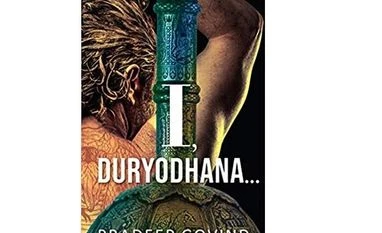
Verbosity is tedious, except perhaps in the young and in-love. In a book, though it may seem paradoxical, it is recipe for disaster. Too many words can suck substance and style out of the most powerful story and, worse, scar readers for life. I Duryodhana offers just such a tragic fate to those who have a taste for the bustling genre of mythological fiction.
The author buries one of the most layered characters in the Mahabharata in an avalanche of words, stripping him bare of nuance and mystery. Instead of the powerful force that he was, human and flawed, the book churns up a modern-day avatar better suited for the life of a daily television soap star.
From Duryodhana’s childhood travails to his troubled adulthood and violent death, the book is diligent in recounting the episodes, leaving nothing out and leaving little to the imagination. Instead of painting Duryodhana with contemporary flourish, or presenting a different perspective to the tragic trajectory of his life, the author relies on a mix of colloquialism and gilded prose to retell the story. This is a huge loss. Because Duryodhana does offer up limitless potential. Unlike his cousins, he is not a haloed character. His greys are overpowering and his relationship with his father potent material for any novelist. None of this is explored with depth or craft.
As a result, the original narrative still holds a richer exposition of the character. For instance, in all the stories in the epic, the similarities and differences between Bhima, the Pandava and Duryodhana, the Kaurava prince are interestingly juxtaposed. While the rivalry is eloquently described, it is the subtext, of twin lives separated by destiny and circumstance that spices up the narrative.
The author speaks in the voice of Duryodhana, but denies him a mind of his own. It is as if his actions are completely guided by that of his uncle (Shakuni) or blinded by emotion. Duryodhana seems unable to influence his own behaviour, making him a weak character, not a misjudged one, as the author believes. Duryodhana was never lacking in conviction He was drawn to Shakuni because he believed that this was his only well-wisher in a court full of enemies. He believed that he never was given his due by Bhishma or Vidura and even his guru, Drona; and that his father was a blind king being managed by proxy, who could be easily influenced to deny him his right to the throne. Some of the stories in the Mahabharata talk about his fairness even as they slam him for his arrogance.
Several scholars and commentators of the epic believe that Duryodhana was an upholder of raj dharma, the rule of the kings. The Mahabharata is a story of the growing spread and influence of Vaishnavism and the expanding cult of Krishna, which was keen to set out societal structures sanctioned by religion, not state. In such a situation, Duryodhana and his way of life had to fail. It would have been interesting if the author of this book had brought in the way society today is going through a similar churn, in terms of beliefs and political systems at work.
In the past authors and playwrights have explored the story through Duryodhana’s point of view. Bhasa, a popular playwright who predates Kalidasa, wrote three plays around the dilemma faced by the prince who wanted to be king. His plays bring out the pathos of the battlefield, they force readers to question popular logic and challenge their understanding of right and wrong. He addresses the conflict between Duryodhana and Krishna and also how the former refused to acknowledge the latter’s divinity, the only Kaurava to do that.
There is another aspect of Duryodhana’s character that has fascinated many, especially in folk traditions. His caste agnosticism. He accepts Karna as friend and fellow king at a time when the priestly class was eager to enforce a more rigid understanding of the caste system. The book could have dug deeper into this too. And then, if these strands were too political for an author looking to entertain, Duryodhana’s psychological demons were ripe for the plucking too. However, all of this is left by the wayside as the book plods its way through the familiar and known world.
I, Duryodhana
Pradeep Govind
Om Books; 344 pages, Rs 295
Read this article for free
Register to continue reading premium journalism and analysis from Business Standard.

 "Mindless mining of epics")












 Connect with us on WhatsApp