Monumental world contained in Bireswar Sen's miniature landscapes

A retrospective focuses the magnifying glass on the monumental world contained in Bireswar Sen's miniature landscapes
Miniature landscapes
Ritika Kochhar
Last Updated : Sep 29 2017 | 11:32 PM IST
In an essay about his teacher, Abanindranath Tagore, Bireswar Sen (1897-1974) writes: “In order to judge the greatness of a man, we must bear several things in mind: whether he is great by himself, or great through other circumstantial or contributory causes; and whether his greatness is purely parochial and transitory, or universal and far–reaching in its effects.”

It’s a useful way to look at Sen’s works as well, especially to understand if they’ve stood the test of time. Despite being regarded as a master during his lifetime, his works, while in the permanent collections of various museums in India and Pakistan, have been largely forgotten — perhaps because their size and usage of watercolours cause them to pale in front of larger, more colourful works.


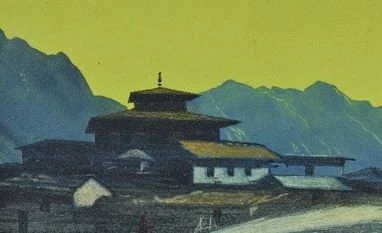
It’s only in a solo retrospective, “Reflections: Man and Nature in the Paintings of Bireswar Sen”, that the incredible beauty of Sen’s watercolours — most of which are about 2.5 x 3.5 inches — reveal their real magni-ficence and make you understand what artist-teachers like B N Goswamy mean when they say, “Without information about traditions, understanding would be flawed”. 

Sen’s watercolours immediately build this linkage with the best traditions of Indian art — including miniature art, Buddhist art, Bengal School and the Japanese artists who came to teach in Kolkata and Santiniketan, as well as Nicholas Roerich’s incredible Himalayan artworks. But his works aren’t copies. He has studied the traditions of Indian art with a deep intelligence and has interpreted the “spirit of the age” in his own work.


This deep study is clearly emphasised in this retrospective owing to its chronological style. The 70 paintings in the exhibition clearly show the change in his style and colour palette as we move from the early 1900s to the works painted in his last decade. 

Almost all of them are watercolours on paper, and the small sizes make it essential to use a magnifying glass to make out the details. But within these incredibly tiny spaces, Sen creates detailed landscapes. Throughout all his miniatures, the mountains and landscapes are filled with light and they seem to glow, but while the earlier ones are awash with glorious grey and dusky green/blue palettes, Sen’s meeting in 1932 with Roerich, the Russian artist and fellow Himalayan enthusiast, seems to have changed his colour palette entirely.


The later watercolours are layered with brighter and darker colours. Most paintings also have tiny figures that help put into perspective the size of the mountains and the monuments he has painted. These contrasts between the scale of the mountains and the smallness of the paper and individuals, together with the delicacy of the brushstrokes and medium, are what make this retrospective so overwhelming. Many of the most beautiful and intricate works in the retrospect are from 1974 — the year of his passing. It’s incredible to think that at the age of 77, the artist was still prolifically producing masterpiece after masterpiece.

Many of the works are from 1974 — the year of Sen’s passing. At the age of 77, he was still producing masterpiece after masterpiece

 
But Sen wasn’t just an artist, and the prettiness and poetry of each work’s titles show his alternative career choice as an English teacher. He was 21 when he met writer-artist Abanindranath Tagore and Nandlal Bose, and went on to study under Tagore at the Indian Society of Oriental Art for six years. You can see Sen’s earlier trysts with traditional Bengal and Indian miniature styles clearly in his drawings.  He taught English at Patna College from 1923, and then taught art at the School of Arts and Crafts, Lucknow, from 1926. 

He was already considered one of the most prominent landscape artists of modern India when he met Roerich. It changed him and his works in many ways. He wrote that Roerich’s paintings of the Himalayas had “a luminosity which seemed to come as much from the startling brilliance of the colours he used, as from the fire that burned within”. Sen’s own artworks were also collected by Lord Irwin, Russian ballerina Anna Pavlova, the maharajas of Patiala, Mysore, Travancore, King Birendra of Nepal and Dorabji Tata.

This retrospective, which has been mounted along with the Bireswar Sen Family Trust, also contains photographs of the artist and his friends as well as letters written by Roerich to him. There is also his sketchbook and even multimedia renderings of his artworks, so that we can “add to nature what it does not possess: the mind and soul of man”.
‘Reflections: Man and Nature in the paintings of Bireswar Sen’ can be viewed at the National Gallery of Modern Art, New Delhi, till November 14, 11 am to 6.30 pm

One subscription. Two world-class reads.

Already subscribed? Log in

Subscribe to read the full story →
*Subscribe to Business Standard digital and get complimentary access to The New York Times

Smart Quarterly

₹900

3 Months

₹300/Month

SAVE 25%

Smart Essential

₹2,700

1 Year

₹225/Month

SAVE 46%
*Complimentary New York Times access for the 2nd year will be given after 12 months

Super Saver

₹3,900

2 Years

₹162/Month

Subscribe

Renews automatically, cancel anytime

Here’s what’s included in our digital subscription plans

Exclusive premium stories online

  • Over 30 premium stories daily, handpicked by our editors

Complimentary Access to The New York Times

  • News, Games, Cooking, Audio, Wirecutter & The Athletic

Business Standard Epaper

  • Digital replica of our daily newspaper — with options to read, save, and share

Curated Newsletters

  • Insights on markets, finance, politics, tech, and more delivered to your inbox

Market Analysis & Investment Insights

  • In-depth market analysis & insights with access to The Smart Investor

Archives

  • Repository of articles and publications dating back to 1997

Ad-free Reading

  • Uninterrupted reading experience with no advertisements

Seamless Access Across All Devices

  • Access Business Standard across devices — mobile, tablet, or PC, via web or app

Next Story



