Mumbai's brush with Delhi
With a repertoire of 30,000 artworks spanning 250 years, Delhi Art Gallery comes as a welcome addition to Mumbai's artscape
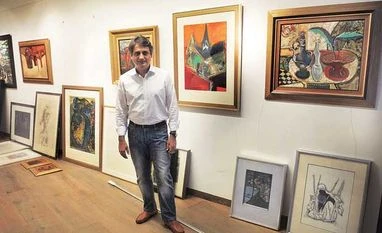
Ranjita Ganesan Mumbai Delhi looks set to share some rare possessions with its rival city. At a time when Mumbai's art market has been struggling with galleries either closing or downsizing, Delhi Art Gallery's decision to open a branch in the historic district of Kala Ghoda in Fort is likely to boost morale, according to industry experts.
Known for an exhaustive collection of modern art, DAG will start with a show on the Progressive Artists' Group, which includes the works of masters FN Souza, SH Raza, MF Husain, SK Bakre, HA Gade and KH Ara. Progressive Artists' Group launched in Mumbai in 1947 as a movement to shift away from British leanings and develop Indian modernism was later joined by artists such as Vasudeo Gaitonde, Akbar Padamsee, Tyeb Mehta and Krishen Khanna. 225 paintings by all members of the group have a combined value of Rs 100 crore, making it one of the largest openings in the country. "It shows confidence on the part of the art dealer, who is really the barometer of the art market. It will give confidence to collectors," says Bijay Anand, art consultant and collector.
The paintings on display, all of which will be on sale, are also owned by DAG. The gallery has been acquiring with aggression, adding paintings on a daily basis, says DAG Curator Kishore Singh. This has also given it the confidence to set up shop in the city, says DAG Director Ashish Anand. "We buy when the market is up and even more when the market is down. So that when things pick up, we do well."
The repertoire has 30,000 works of art spanning 250-300 years and its vastness, says Singh, will allow people to see how art has evolved. The exhibition will be curated in a manner that will depict the journey of forms like distortion, cubism, high modernism and contemporary.
* * *
Since paintings at DAG usually have "a beautiful, museum-quality" about them, Bijay reckons they will invite a new breed of art lovers. "Previously, we only had a market of art investors and that destroyed the market." Those who had favoured artworks by the masters were relatively insulated from the dramatic crash in the market post-2008. Galleries and collectors in Mumbai who bought contemporary art based on speculation at the time got burnt badly, says Bijay. Prices of contemporary art fell 60-70 per cent, while the masters saw a decline of 15-20 per cent and coped relatively better.
According to Anupa Mehta, director of The Loft at Lower Parel, established artists have always seen steady demand but the market seems willing to put down money on increasingly select and key works. DAG's inventory of works that go beyond the moderns will be a welcome addition to the city, says Mallika Advani, independent art consultant who also works with auctioneer Pundole's. The gallery will need to be careful about pricing works correctly for the current market scenario, she adds. "Overpriced works do not sell today, as collectors are very aware of price levels and have enough of a choice to be fairly choosy about what they buy."
DAG's entry and the Christie's live auction in Mumbai in December will bring exuberance and excitement to the art scene, expects gallerist and consultant Farah Siddiqui. DAG plans to hold six or seven major shows a year introducing styles ranging from nudes to abstraction and pre-Independence Maharashtrian art, says Ashish. Among the unique works on display in the opening are Raza's
Witness 1980-2002, which was a surface for wiping excess paint off brushes before he turned it into an artwork, and Khanna's
Suspense at Last Supper, in which he transports a biblical scene to the local
dhaba.
* * *
DAG, which exceeded its sales target in 2011 but missed expectations in 2012, expresses confidence about outperforming this year. The gallery had its beginnings in 1993 in Delhi, where it was started by Rama Anand. Son Ashish took over in 1996. He has plans to take the outfit to Dubai next. The idea to step into Mumbai was not recent. The team had been scouting for a location for four years before it chanced upon the 150-year-old building in the neighbourhood of Jehangir Art Gallery and Sabyasachi. Delhi-based architects Morphogenesis spent a year and a half in the restoration of the four-storeyed structure, now freshly coated in beige and white. Two floors have been reserved for exhibitions, the third will be used to display a permanent collection and the last level will turn into a space for interactions.
The Delhi Art Gallery opens for viewing in Mumbai today.

 "Mumbai's brush with Delhi")


 Connect with us on WhatsApp