NWBCT: Nagaland's trust is working to prevent killing of Amur Falcon

A conservation trust in Nagaland is working to prevent the ruthless killing of the Amur Falcon during its brief halt in the state
weekend
Geetanjali Krishna
Last Updated : Nov 25 2017 | 1:10 AM IST
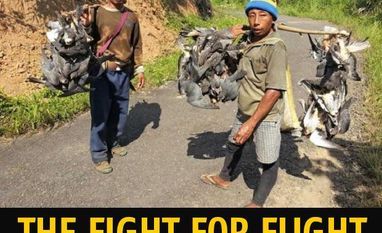
It was October 2012. A team of conservationists visited a remote dam in Nagaland to study the migration behaviour of a bird of prey, the Amur Falcon, which roosts here for a month every year as it makes its way from its breeding grounds in Mongolia to Africa. When they reached the Doyang reservoir in Wokha district of Nagaland, they found that the birds were being massacred en masse. Trees on the banks of the reservoir were covered in nets that trapped them by thousands. The air was thick with the smell of their meat being smoked. Local tribes who have a long tradition of hunting (not just for the table but also as a means of livelihood) sold the meat of the falcons as far as Dimapur, 120-odd km away. Many confessed to earning over Rs 20,000 selling falcon meat in the one month that these birds stopped in Wokha to roost and recuperate from their long flight. They referred to this cruel annual practice as a “harvest”.

The team from Conservation India that witnessed this massacre was led by Bano Haralu, a former TV journalist and founding trustee of the Nagaland Wildlife and Biodiversity Conservation Trust (NWBCT). While some conservationists suggested financially incentivising locals to not kill the falcons, Haralu had a different take. She believed that education and not compensation would eventually enable her fellow Nagas to stop killing Amur Falcons. “I’ve always believed that the conservation of our wild spaces and species must be its own reward,” she says. “By rewarding locals with money for every falcon they saved, we’d defeat the purpose of conservation.”

What ensued was a successful campaign to alert the wildlife community, as well as the state government, about the falcons’ grisly fate in Pangti, Pungro and Okhtosto, the three villages in Wokha district. Finally in 2013, just before the migratory season of the falcons commenced in October, the Pangti Village Council announced a ban on their trapping and killing. The state government instituted stiff penalties for falcon hunters. And that year, Nagaland earned the title of the “Falcon capital of the world”. This was the first step towards sensitising communities. 

“Next, we started working to instil a sense of pride that this mysterious bird flew from so far, to come and roost on our land,” says Haralu. NWBCT initiated a comprehensive programme to change local attitudes towards hunting with the support of the government, as well as leading conservation NGOs such as Wildlife Conservation Society, Birdlife International, the Bombay Natural History Society, the Raptor Research and Conservation Foundation, and the Wildlife Conservation Trust. They set up weekly eco clubs for children, went door-to-door to talk to villagers and engaged with the village councils.” In the eco club, children learn to identify the flora and fauna in the forests around them,” she says. “They also learn about the miracle of the Amur Falcons’ migration — the fact that their five-day flight across the ocean from here to Africa is the longest non-stop overseas flight among all birds; that farmers in faraway Africa await their arrival for these raptors feed on locusts and help get farmlands ready for the next crop.” Recently, NWBCT also convinced the Pangti village council to ban the use of air guns, principally used to hunt birds and smaller animals.

Eventually, the state government asked NWBCT to prepare bio-diversity checklists and partnered with them and the local community to launch the Friends of the Amur Falcon campaign. Supported by institutions such as the Raptor Research Conservation Foundation, the Bombay Natural History Society and the Wildlife Conservation Society, Haralu aims to intensify the training of not only NWBCT’s eco club teachers, but also local birding guides. “We’re training locals to set up homestays for birding enthusiasts in the Amur Falcon roosting hotspots,” she says. Further, NWBCT wants to further strengthen their four eco clubs (each of which costs about Rs 1 lakh per annum to run), as they’ve been instrumental in deepening the relationship between local communities and their environment.

The NWBCT model demonstrates how an attitude change in individuals can have a larger social impact. Moreover, it highlights the critical role local communities can play in successful conservation — for it is when they feel they have a tangible stake in their environment, that hunters too can become protectors of wildlife.
For more, visit www.nagalandconservation.in
Next, a community of youths has come together to become the voice of beleaguered Indian artisans facing oblivion

One subscription. Two world-class reads.

Already subscribed? Log in

Subscribe to read the full story →
*Subscribe to Business Standard digital and get complimentary access to The New York Times

Smart Quarterly

₹900

3 Months

₹300/Month

SAVE 25%

Smart Essential

₹2,700

1 Year

₹225/Month

SAVE 46%
*Complimentary New York Times access for the 2nd year will be given after 12 months

Super Saver

₹3,900

2 Years

₹162/Month

Subscribe

Renews automatically, cancel anytime

Here’s what’s included in our digital subscription plans

Exclusive premium stories online

  • Over 30 premium stories daily, handpicked by our editors

Complimentary Access to The New York Times

  • News, Games, Cooking, Audio, Wirecutter & The Athletic

Business Standard Epaper

  • Digital replica of our daily newspaper — with options to read, save, and share

Curated Newsletters

  • Insights on markets, finance, politics, tech, and more delivered to your inbox

Market Analysis & Investment Insights

  • In-depth market analysis & insights with access to The Smart Investor

Archives

  • Repository of articles and publications dating back to 1997

Ad-free Reading

  • Uninterrupted reading experience with no advertisements

Seamless Access Across All Devices

  • Access Business Standard across devices — mobile, tablet, or PC, via web or app

Next Story


