Objects of desire

It is known that chilli came to India with the Portuguese, there is, for example, no reference to chillies in the recipes of the Mughal court written by Abul Fazl in the Ain e Akbari
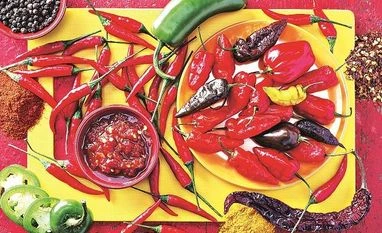
Bhut Jholakia
Aakar Patel
Last Updated : Nov 17 2018 | 12:01 AM IST
One of the things that I like to eat (and I know it is very un-Gujarati of me) is pork cooked in Naga style — that is to say cooked lightly in its fat with no masala but with bamboo shoot and a chilli known as Bhut Jolokia. This is a murder weapon of an ingredient, in case you are not familiar with it.

It is known that chilli came to India with the Portuguese, who brought it with them from South America. There is, for example, no reference to chillies in the recipes of the Mughal court written by Abul Fazl in the Ain e Akbari, written in Farsi in the 16th century. The word we use for chilli (mirchi) is spelled with “cha”, which Arabic does not have but Farsi does, and so if it did exist in the time of Akbar we would likely know it from the same name.

My guess is that the Bhut Jolokia, also called Raja mirchi, is native to India. There is nothing like it anywhere in the world including in South America.

The other fabulous and highly prized (by me) chilli is the Dalle, found in Bhutan, Nepal and Darjeeling. This is a round thing, called fireball by some people. The form that I like it in is not as a pickle, as is generally available, but just by itself in brine or vinegar.

Unfortunately for me, neither the fresh Bhut Jolokia nor the Dalle is easily available online. As far as I know, and I have done research here, they are not available at all. Smoked Bhut Jolokia is available, and happily it is that form which is used in the pork. However, the fresh thing is also super but not to be found. The Dalle in vinegar used to be available till some time ago, but then the company making it shut down, according to the online retailer.

Another thing that I enjoy with my drink is a lime the Bengalis call Gandharaj, meaning the king of aromas. It is a fragrant thing, which doesn’t produce much juice and has a lot of seeds, but is streets ahead of the ordinary nimboo. Again, this is almost impossible to find in any market anywhere in India. One can only access it in Kolkata and parts nearby, though given the vast numbers of middle-class Bengalis living in many of our cities, it should be available more widely.

When we visited my family in Surat, my wife, who is Bengali, was surprised by a dish that my father procured especially for her. It is called Kaachu and it is made by one Gujarati community, the Khatris, only in Surat. The name means “uncooked” and it is goat’s brain that is served as a paste with cream, salt and green garlic shoots.

It is quite astonishing in that it is delicate, uncooked and un-Indian in many ways (meaning not killed with masala as is our wont to do in all of our cooking). It would not be out of place in French cuisine. Another Surat food that you may not have encountered, though most Gujaratis will know it, is Ghari. This is a heavy and dense sweet that is meant to be eaten on one night of the year, Sharad Poornima. The fridge in my house in Bengaluru always has a couple of boxes of it. Yet another Gujarati thing usually in my fridge is packets of Bhakri, which is biscuit-like roti/bread substitute which is baked. When there is leftover subzi or daal or something. There is a point to this column, I promise, and I will come to it in a bit.


I was travelling to Chhattisgarh on work sometime ago, and I encountered at the Raigarh railway station a man selling enormous guavas. This is my favourite fruit, but I had never seen something of the size that he had. It was as big as two fists together, and completely uneven and gnarled, meaning that it was a desi fruit and not an import. It was not dense and it had the faint taste of camphor. It was spectacular and I wish I could access it more easily, though, of course, I cannot and Chhattisgarh is notoriously difficult to travel to.

My question, and here is the point I am making, is: why can I not access all these things — Bhut Jolokia, Dalle, Kaachu, Bhakri, Ghari and everything else — more easily? Surely it cannot be that other Indians do not like these things. I can see people turning up their nose (I do not) at beef or pork but this is not the same thing. These are Indian things that appeal to Indian palates.

Again I am not talking about things like Malaiyyo, which is an extremely refined, light-as-air dessert made in Varanasi and sold only in the first half of the day and only in winter. That is food as art, and the reason it is not available in the rest of India is that not everyone can make it even if there were demand.

I can understand it if some of these things are not available because of the weather or geography.

Girish Karnad and my wife were speaking about paneer and he said to her that the cows in the south of India did not produce milk fatty enough to make rich things like paneer. But most of the things that I am writing about — and many others besides — do not need any special climate. Indians prize themselves on being able to eat very spicy food. Then how come we don’t get dry Bhut Jolokia in every store?

The fact is that we don’t and we’re a poorer culture because of it.

One subscription. Two world-class reads.

Already subscribed? Log in

Subscribe to read the full story →
*Subscribe to Business Standard digital and get complimentary access to The New York Times

Smart Quarterly

₹900

3 Months

₹300/Month

SAVE 25%

Smart Essential

₹2,700

1 Year

₹225/Month

SAVE 46%
*Complimentary New York Times access for the 2nd year will be given after 12 months

Super Saver

₹3,900

2 Years

₹162/Month

Subscribe

Renews automatically, cancel anytime

Here’s what’s included in our digital subscription plans

Exclusive premium stories online

  • Over 30 premium stories daily, handpicked by our editors

Complimentary Access to The New York Times

  • News, Games, Cooking, Audio, Wirecutter & The Athletic

Business Standard Epaper

  • Digital replica of our daily newspaper — with options to read, save, and share

Curated Newsletters

  • Insights on markets, finance, politics, tech, and more delivered to your inbox

Market Analysis & Investment Insights

  • In-depth market analysis & insights with access to The Smart Investor

Archives

  • Repository of articles and publications dating back to 1997

Ad-free Reading

  • Uninterrupted reading experience with no advertisements

Seamless Access Across All Devices

  • Access Business Standard across devices — mobile, tablet, or PC, via web or app

Next Story



