Sanjay Leela Bhansali’s Padmaavat starts with perhaps the longest list of disclaimers in recent history. No word or synonym is spared to ensure that all bases are covered. But for all the brouhaha around it and the violent protests it has invited, the film is quite bland.
As far as visual spectacles go, Bhansali is a master at delivering stunning frames. But Padmaavat is not his best offering – not even by a long shot. It’s a watchable film, no doubt, but is burdened by a long runtime (163 minutes), slack editing and some really shoddy post-production work.
The film gets its casting spot on. Deepika Padukone as Rani Padmavati is elegant and poised, if somewhat wooden at times. Bhansali could have fleshed out her role better. Padukone is left with little dialogue and nothing in terms of character development, barring one or two scenes that demonstrate her presence of mind.
Ranveer Singh as Alauddin Khilji is the star of the show. He owns the character, its viciousness and excessiveness wholeheartedly, and delivers a performance that should make the viewer cringe but instead impresses. At one point, he casts aside a flower he is holding because he is disappointed that it’s Ratan Singh and not Padmavati who has come visiting. It makes him look like a sulky brat, which is essentially the basis of his obsession with Padmavati – the desire to own every beautiful thing in the world, no matter how.
The surprise comes in the form of Shahid Kapoor who, as Ratan Singh, holds his own in most scenes. Jim Sarbh is fun to watch as Khilji’s trusted slave general – creepy, maniacal and hilarious in parts. Aditi Rao Hydari as Khilji’s wife Mehrunisa too is impressive.
Though the film starts off well, the first half is excruciatingly long. We’re introduced to the proud and power-hungry Khilji, and within 10 minutes, the audience knows the kind of villain he is. While Kapoor and Padukone’s scenes do well to set the tone of the film, the ones involving Ratan Singh’s first wife, Rani Nagmati (Anupriya Goenka who has little to do other than pout), are plain unnecessary.
Here too, Bollywood’s obsession with song and dance interferes with the pace of the film. While the controversial Ghoomar is a visual delight (despite some pretty obvious covering-up of Padukone’s midriff, thanks to the Karni Sena’s protests), some songs only increase the length of the film without adding anything substantial to it.
The film picks up in the second half, becoming fast-paced and precise, with some great sequences, including a fight scene between Khilji and Ratan Singh. The background score lifts the scenes, most prominently the concluding sequence where the women, led by Padmavati, proceed en masse towards the burning pyre to commit jauhar.
Bhansali is adept at shooting extravagant, larger-than-life scenes: those of the fort, of the opulence of the Khilji dynasty and of the battle. But the visual effects team lets the film down. Whether this was a result of the numerous changes that were asked of the film (exactly how much was retouched one will never know) or just shoddy work, there are a few glaring continuity errors that throw the audience off. For example, Padukone’s unibrow is missing in some scenes. Similarly, she and Kapoor appear tanned in some scenes, less so in others.
The dialogue writers, too, have failed to stay true to the ethnicity of the characters. Go back a few years to Jodhaa Akbar, where Hrithik Roshan’s dialogues are richly sprinkled with Urdu. In Padmaavat, the Marwari accent comes and goes. For a period drama, these are glaring misses.

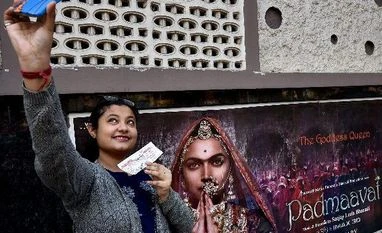 "Padmaavat Movie Review: A bland and tediously long film")

