Rethinking village life
The author finds out how farmers in Bharatpur are tweaking traditional methods to reap big benefits
Geetanjali Krishna Meet Ranvir Singh of Adhaiya village in Bharatpur. One-and-a-half years ago, like his other neighbours he was ekeing a living from arid farmland and the four buffaloes he kept. Today, he has the same farm and the same animals - but his income has trebled. "I have invested in a proper shed for my cattle so they stay cool in summer and planted more nutritious fodder for them. I have also built a hydroponic shed where I sprout the grains I've always fed my cattle - wheat, barley and corn," he says proudly.
Consequently, milk production has gone up from eight to 12 litres per buffalo and the fat content of their milk has increased from 6 to 7.5 per cent. "I now get Rs 45 a litre for the milk, instead of Rs 32 that I got earlier," he says. Singh has also invested in a small biogas unit. "The biogas is enough not only to keep my home fires burning, but also to power the chopper in which I process the cattle's fodder," he says. "The slurry that is left in the gas unit is a great natural fertiliser and the fact that I grow organic vegetables has enabled me to get a better price for them in the market."
Singh is not the only farmer in Bharatpur who has tweaked his traditional agricultural style to reap considerable benefits. Travelling through the villages of Bharatpur last week, I meet many such farmers. "In India, farmer suicides are largely because they are dependent on their income from rain-fed farming. Our aim is to develop ancillary sources of livelihood, so that farmers also have secondary incomes," says Sita Ram Gupta, executive director of LupinHuman Welfare & Research Foundation. Lupin Foundation has been working in Bharatpur for the last 27 years to provide a sustainable and replicable model of rural development that focuses simultaneously on several aspects of village life.
"Over the years, we've found that working on just one aspect of rural economic development like agriculture or animal husbandry doesn't effect a lasting change," says Gupta. Instead, the foundation has a three-pronged focus on creating economic opportunities (by providing training in traditional and modern skills), infrastructure development (like revamping schools, primary health centres, and testing and improving soil) and social development.
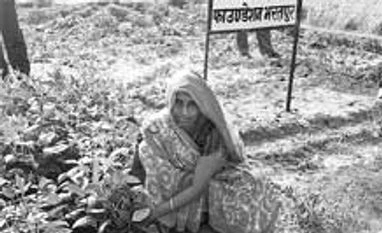
When I visit Paharsar and Sheorana, two of Lupin's "model" villages (there are 43 of them in Bharatpur alone), I see how this works on the ground. With the help of a special village committee and the pradhan (village head), the foundation has worked on developing biogas plants, organic farming techniques and alternative skills training. It has also revamped community spaces like the health centre, schools and religious monuments. "The soil quality was quite poor, but due to the addition of compost and slurry from the biogas plants, our fields have become very productive," says Bacchu Singh, the pradhan of Paharsar as we walk through fields of okra and brinjal. "Now that the school has also been refurbished, we're ensuring that every child of the village is enrolled in it," he adds. "And because of Lupin, our medical centre is so good that people from the 15 villages around us come here for treatment."
At the community centre, I notice a young fellow with a computer. He is making ration cards, birth and death certificates and other documents for the entire village. All the houses are now pucca, and 80 per cent have attached toilets. Many village women are members of Self Help Groups and have set up tailoring and embroidery units within their homes.
Sheorana is a similar story, with clean lanes and ample drainage. I meet Chakradhar Singh, who has a flourishing cattle shed. Lupin, he says, has taught him about optimal feeding practices and good cattle breeds. "Looking at how successful my cattle shed is; many other people have adopted similar practices."
An important learning from Lupin's work in Bharatpur is how spreading awareness about government schemes and helping villagers to use them can have a significant economic impact. "The government has many good schemes (like for pension and insurance) and subsidies (such as the 50 per cent off on biogas plants). We've helped countless villagers avail these benefits," says Swati Samvatsar, chief programme manager at Lupin Bharatpur. "We're currently aiming to get government life and accident insurance cover for every individual in every village we're working in. We've successfully helped many villagers obtain small loans from organisations like Small Industries Development Bank of India and Nabard to increase their business, instead of them having to turn to traditional moneylenders."
As we drive out of Sheorana past vegetable fields, the impact of Lupin's holistic development model upon Bharatpur is palpable. "We advised villagers to grow and sell the same vegetable collectively because selling in bulk is easier and gets them better prices," says Samvatsar.
"Our aim is to make Bharatpur a region without a single Below Poverty Line family by 2017," adds Gupta. Whether or not Lupin Foundation manages to enable every single household in the area to leap across the poverty line, one thing is clear: it has certainly created a scalable, holistic model of rural development which, by augmenting the farmers' non-farm incomes, has the potential of ending the financial uncertainty of their lives and livelihoods.
For more, log on to
lupinfoundation.in/ or visit its Facebook page; next fortnight, the story of a visionary enterprise that is bringing organic vegetable gardening to urban apartments, one balcony at a time

 "Rethinking village life")


 Connect with us on WhatsApp