Kokbahal village in the Raigarh district of Chhattisgarh, located some 100 km from the district headquarters of Raigarh town, wears a deserted look today, with a desultory dog in the neighbourhood. There are few people around. But just 15 years ago, it was a mini town buzzing with activity. Its kachcha roads had vehicles carrying “Government of India” signs zooming around and “people wearing hats”, the villagers recall, busy with their work of drilling into the earth at various places in the area or installing equipment in search of “something”.
Those posted at the village for the mysterious activities built concrete houses. The densely-forested, tribes-dominated pocket, now identified as a Naxal infested locality, seemed to come alive with activities reflecting the modern lifestyle of people from urban areas. But all too soon, after working at the location for nearly three years, the scientists wound up operations, dismantled the network of houses and deserted the place.
What they left in their wake are suspicions about a huge uranium deposit under the village.
“They drilled at many places and said they were taking the samples to state capital Raipur,” says Bheema Behra, a village inhabitant, “but they never revealed what the operation was all about.” The team that camped in the area was reportedly from the Atomic Minerals Directorate for Exploration and Research (AMD). Neither the Chhattisgarh government nor the district administration was briefed about the outcome of the prospecting.
An email sent to the director of AMD enquiring about the result of the three-year-long survey in the 56 villages bordering Odisha did not get a response. The AMD website, however, mentions the possibility of uranium deposits in the region and says “multidisciplinary investigations have been taken up in search of unconformity-related uranium deposits in Chhattisgarh and Orissa (Odisha)”.
* * *
An AMD map referring to the important proterozoic basins of India as target areas for uranium exploration includes the Chhattisgarh basin that covers the regions of Baramkela and Dongripal, of which Kokbahal village is a part.
“Though uranium reserves have not been proven here, hypotheses and the sequence of events that took place in Kokbahal are in tandem with high radioactive emissions having been recorded in the area,” says radiologist and social worker Parivesh Mishra. These seem to indicate there are huge deposits of radioactive substance, probably uranium, in the region, he infers.
Mishra cites examples to substantiate his suspicions. “There was a spurt in the diagnosis of diseases caused by radioactive emission,” he says, adding that the incidence of tuberculosis and cancer was proportionately high when compared to data from other parts of the region. In a few villages, cases of physical deformities in newborns, besides mental retardation, were also reported, he adds.
“We don’t know whether it was mere hearsay or a fact, but there was large-scale apprehension that radioactive emission had been identified in one pocket during the sample collection,” says Behra. “It frightened the villagers.”
For generations, the impoverished tribal families had lived in these villages, unaware of the radioactive substance they were tilling in their fields and the possible ill effects of their exposure to it. Mishra says there was deep drilling in the area that resulted in more radioactive emission. Some conjecture that since uranium is a sensitive mineral of strategic importance, the reserve might not have been notified. “If there was no trace of uranium in Kokbahal, why did the AMD team camp for three long years and work in secrecy in the thick forest areas?” asks Mishra.
According to the doctor who had a few conversations with the scientists prospecting for uranium in the area, the AMD team that surveyed the area hadreported to the Hyderabad headquarters of theorganisation, while the samples collected were sent to a Nagpur laboratory.
The local post office in Dongaripali village area establishes the presence of the AMD team. While expressing the wish not to be quoted, an employee disclosed that the otherwise sleepy post office had seen a flurry of activities, leading to a jump in the postal economy. “Money transfer was frequent from Hyderabad and Nagpur,” he says, adding that for three years thepost office registered record business in the district.
According to district officials, ascertaining the exact year when Kokbahal attracted the secret attention of the government is not possible, but the first survey camp was set up in Salar village in the district some time in the mid-1990s. The second location where survey was carried out was in Dongaripali near Kokbahal village in 2001, while the third was stationed at the Singhora Public Works Department rest house.
* * *
Today, neither the people nor the politicians talk about uranium. The former know little about the subject, the latter perhaps avoid speaking about something that could have strategic implications for the country. Mining of uranium could change the socio-economic condition of the region. But the politicians avoid any public discussions on the topic. “There are reports of huge uranium ores here, but we don’t want to talk about the issue as people may not take it in a positive way,” says Congress leader Ghanshyam Manhar. For one, mining will certainly lead to displacement of villages, a matter that can prove troublesome for politicians. In the recently concluded state polls, no political party touched upon the issue during campaigning, despite the fact that uranium would bring the region into national and international highlight.

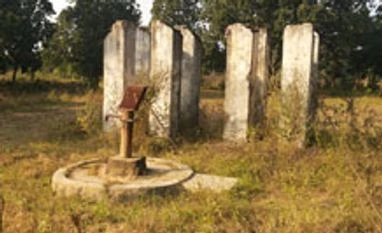 "The half-life of Kokbahal village")


 Connect with us on WhatsApp