Unidentified flying objects

Indian mythology is living through some truly interesting times. Faith in its veracity has never been higher
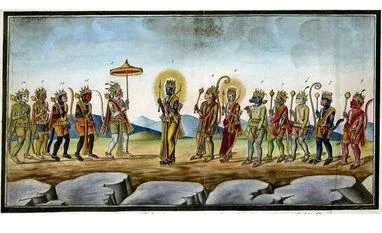
ram, rama, ramayana
Arundhuti Dasgupta
Last Updated : Jan 12 2019 | 12:19 AM IST
When Ravana abducted Sita and whisked her away on his flying chariot, was he in fact the world’s first aviator? When Hanuman leapt over the oceans, did he do what man still has not been able to? Fly like a bird.

Indian mythology is living through some truly interesting times. Faith in its veracity has never been higher. Even among scientists and technology mavens — typically communities that tend to view the world through the lens of logos or reason and not mythos, there is a shiny-eyed enthusiasm for the mythical world. At the recent Indian Science Congress, myth found a special place of honour in several of the papers that were presented by eminent scientists and educationists.

But in its hour of triumph, myth is being stripped of its meaning. All that made myth a sacred tale and imbued it with permanence, in the rather fickle landscape of human memory, is being lost as modern-day interpreters choose to look at these stories as a bunch of facts. Worse still, many seek to conflate myth and history.

This is not the first time such an attempt is being made. It is human nature to seek glory in one’s past, but to use myths to do that is not just shortsighted but also dangerous. Loss of perspective, as such pronouncements indicate, could turn a rich heritage of myth, epic and legend into drivel.

S A Dange writes that the epics Ramayana and Mahabharata are classified as “íti-ha-asa” (this way-indeed-it was) in Indian literature (Understanding Hindu Myths). Dange says that much is lost in translation when history is equated with itihasa; it leads to statements such as Ravana flying his chariot into 24 airports or India being a pioneer in plastic surgery because Ganesha’s head was replaced with that of an elephant.

Besides it is not just Indian myths that have stories of flying gods and objects. Greek mythology has them too. Phaethon, son of Helios and the nymph Klymene, begged his father to let him hold the reins of his chariot led by immortal steeds. Helios, unable to refuse his boy’s wish, gave in against his better judgement. But he warned Phaethon to be careful. For the chariot needed an even pace and a steady hand on the horses. But an impatient Phaethon quickly threw his father’s words to the wind as he raced closer and closer to the sun. The horses broke into a frenzied run and the chariot caught fire setting the earth ablaze. Appalled by the destruction, Zeus hurled his thunderbolt at the boy and Phaethon fell dead into the ocean. Should we then infer that the Greeks flew airplanes and that Helios built airports in the sky?

Another Greek hero was Daedalus. He had been imprisoned by the king of Crete, Minos, for a transgression. Daedalus and his son Icarus were held captive on a remote island. But Daedalus, the greatest among mortal craftsmen, plotted his escape. He fashioned two sets of wings, made from wax and feathers for himself and his son. He strapped them on and warned Icarus not to fly too close to the sun or the wax would melt. But like Phaethon, Icarus did not listen to his father either and crashed to his death. Daedalus, however, is believed to have flown to safety. Does this mean that Daedalus knew how to fly?

In the Ramayana, Hanuman flew to Lanka to deliver Rama’s message to Sita. Some stories also talk about his flight as a child because he wanted to catch hold of the sun. Flight has been a long-standing human ambition and it was thus inevitable that mythmakers experimented with this desire. Their stories and descriptions are an example of the richness of human imagination that powered these myths.

Scholars have defined myth in different ways but there is unanimity in their understanding of myth as an early exploration of ideas. Myth is how humans sought meaning in their lives, says Karen Armstrong (A Short History of Myth). Armstrong writes that another peculiar characteristic of the human mind is its ability to have ideas and experiences that we cannot explain rationally. “We have imagination, a faculty that enables us to think of something that is not immediately present, and that, when we first conceive it, has no objective existence. The imagination is the faculty that produces religion and mythology,” she said. The imagination has also led us to amazing scientific discoveries, but not by fabricating a past and trampling over the nuanced meaning of mythology.


One subscription. Two world-class reads.

Already subscribed? Log in

Subscribe to read the full story →
*Subscribe to Business Standard digital and get complimentary access to The New York Times

Smart Quarterly

₹900

3 Months

₹300/Month

SAVE 25%

Smart Essential

₹2,700

1 Year

₹225/Month

SAVE 46%
*Complimentary New York Times access for the 2nd year will be given after 12 months

Super Saver

₹3,900

2 Years

₹162/Month

Subscribe

Renews automatically, cancel anytime

Here’s what’s included in our digital subscription plans

Exclusive premium stories online

  • Over 30 premium stories daily, handpicked by our editors

Complimentary Access to The New York Times

  • News, Games, Cooking, Audio, Wirecutter & The Athletic

Business Standard Epaper

  • Digital replica of our daily newspaper — with options to read, save, and share

Curated Newsletters

  • Insights on markets, finance, politics, tech, and more delivered to your inbox

Market Analysis & Investment Insights

  • In-depth market analysis & insights with access to The Smart Investor

Archives

  • Repository of articles and publications dating back to 1997

Ad-free Reading

  • Uninterrupted reading experience with no advertisements

Seamless Access Across All Devices

  • Access Business Standard across devices — mobile, tablet, or PC, via web or app

Next Story



