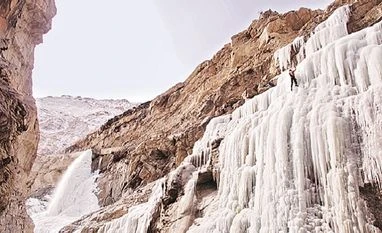
Getting prepared
- The ideal months to embark on one such ascent are between January and March. And hence, it’s important that you spend this summer preparing for it — by training hard and getting your gear together. “Spiti is a high-altitude plateau. Driving in is a bit difficult. After Shimla, roads become narrow, with space enough for only one car. And they are often accompanied by a 500-feet drop. So it can be quite scary getting into Spiti,” says Kowshik.
- It’s of utmost importance to hire an experienced driver from Shimla, who can negotiate the snow on the roads, or have a four-wheel drive.
- ”Since this is a specialised kind of climbing, you need special equipment such as crampons attached to boots, specific ice axes, a base layer and down jacket, and more,” says Kowshik. “This is a capital-intensive sport.” Almost none of this equipment is available in India, and needs to be imported. One way could be to train with a guide and get him to lend the gear to you. “Most climbers buy various components of the gear over the course of several years,” he says.
- Most hotels are closed in the region during the peak of winter, but some homestays keep their doors open for climbers and stray tourists. “Sakya Abode is a good option for accommodation,” says photographer Himanshu Khagta.
Getting trained
- Ice climbing is not for the average tourist or the rookie climber. It is a highly specialised subset of mountaineering and one needs to approach it accordingly. “A friend, who owns homestays in Spiti, tells hilarious stories of tourists, who manage to make it to the region in winter,” says Khagta. “They run out to take a selfie against the snow and ice and run in within two minutes to get back to the warmth of the indoors. The things we do for social media! Ice climbing is definitely not for people like them.”
- The first step in training is building mental toughness. According to Kowshik, this is the most extreme form of climbing. “Ice is a very fluid medium. Frozen water is always breaking and falling on you while climbing. It takes a certain kind of individual to want to go through this challenge,” he says.
- Every year, the ice routes come down and are made again. “You go to climb in the morning, it feels one way. And when you climb in the evening, the route feels another way,” he says. So, one needs to keep one’s mind open and be prepared for all eventualities.
- One needs to be at one’s peak of physical fitness. “Do a lot of rock climbing. Cardiovascular training is very important,” says Kowshik.
- But once you scale that daunting waterfall, the feeling of jubilation is unparalleled. “With icicles on your rope (in extreme climbs) and a constant fight with an alien environment, there’s an even greater high. Climbers talk of a state of inner peace and almost meditative ecstasy,” mentioned an article in The Guardian about this extreme sport.
One subscription. Two world-class reads.
Already subscribed? Log in
Subscribe to read the full story →
Smart Quarterly
₹900
3 Months
₹300/Month
Smart Essential
₹2,700
1 Year
₹225/Month
Super Saver
₹3,900
2 Years
₹162/Month
Renews automatically, cancel anytime
Here’s what’s included in our digital subscription plans
Exclusive premium stories online
Over 30 premium stories daily, handpicked by our editors


Complimentary Access to The New York Times
News, Games, Cooking, Audio, Wirecutter & The Athletic
Business Standard Epaper
Digital replica of our daily newspaper — with options to read, save, and share


Curated Newsletters
Insights on markets, finance, politics, tech, and more delivered to your inbox
Market Analysis & Investment Insights
In-depth market analysis & insights with access to The Smart Investor


Archives
Repository of articles and publications dating back to 1997
Ad-free Reading
Uninterrupted reading experience with no advertisements


Seamless Access Across All Devices
Access Business Standard across devices — mobile, tablet, or PC, via web or app
)