Persistent increase in commodity prices to hurt margins: Apollo Tyres

Firm says it needs 20-25 per cent price hike to offset increase in input costs
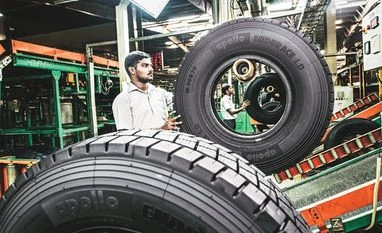
Apollo strives to build brands
File Photo showing an Apollo Tyre manufacturing unit
Shally Seth Mohile Mumbai
4 min read Last Updated : Nov 05 2021 | 12:08 AM IST
Apollo Tyres expects to be a key beneficiary of a sharp recovery in India's automobile market and a pick up in the economy. It would gain from a higher off-take of tyres by the automakers on the one hand and its ripple effect that would result in a steady growth for the replacement demand, on the other.

But even as the demand and volume outlook remains strong, a persistent inflationary trend in commodities has been a pain point and will weigh on the margins, said Satish Sharma, President Asia Pacific, Middle East and Africa

“Businesses across industries are seeing a commodity super cycle and we are no exception. It's a very hurting part. We need about 20-25 per cent increase in price to offset the increase in input costs. It will take 2 years to pass on the whole cost to the end users. We have done half of it and are doing it every quarter. Right now we are chasing the increases and because of this the margins will be impacted,” said Sharma.

The price of every raw material that goes into tyre manufacturing be it a natural rubber, synthetic rubber-- which is a crude derivative, carbon black or steel, have been high. “So far, one has not seen the cost plateauing,” he said, adding that other inputs to production have also been high- be it freight rates, or diesel price.

In a bid to strengthen its product offering further in the Indian market, Apollo Tyres on Friday said it plans to introduce its locally manufactured premium tyre brand Vredestein in India. It would address the premium and luxury segment in passenger cars, while the two-wheeler tyres from the brand would cater to the growing superbiking segment in India. Apollo acquired the Dutch tyre brand in 2009.

The introduction of the Vredestein brand in the premium segment will be margin accretive and will give the company a beachhead among dealers who were only selling imported tyres. The market size for premium tyres in India is 20,000 a month but is expected to grow manifolds as demand for premium and luxury car models and performance bikes is gaining traction.

Meanwhile, elucidating on the company's five-year vision plan as part of which it envisages to be a $5 billion company by 2026, Sharma said, Apollo Tyres has built a lot of inherent strengths in the last few years and it's now ready to capitalise on it. It would be riding on the dual brand strategy of Apollo and Vredestein, an improving economy, higher exports and a sharp recovery in India's automobile sector.

The next five years will be about consolidation and reaping the benefits of investments made in technology, capacity and brands over the last five years, said Sharma."The India operations have done quite well and we have a range play in the tyre market--- from two wheelers and cars to commercial vehicles and off highway," said Sharma pointing out that the firm now leads the replacement segment of the passenger car radial market and will soon be entering the performance segment of the two wheeler market. The company also seeks to benefit from an upcycle in the CV market and an overall improvement in the economy.

The tyre business, said Sharma has a strong linkage to the overall growth of the country. A high focus on infrastructure projects augurs well for the company. "Everybody is forecasting the Indian GDP to have a bull run of 4-5 years and advance at 7-9 per cent," said Sharma. If the real estate boom lasts and the interest rates remain where they are, it would be followed by an investment by the private sector.

Sharma's confidence also stems from the performance of Apollo Tyres' US and European operations and a step up in exports. As of now exports account for 10 percent of the revenue and it's likely to touch 15 per cent in the near future.

Apollo Tyres is at the fag end of the capex cycle. It is operating at ~85-90 per cent capacity utilization. It is expected to conclude the planned capacity expansion by the end of FY2022. "The company is expected to operate at ~65-70 per cent capacity utilization, which gives the company the bandwidth to grow business for another 2-3 years at minimal capex," said a recent research report by Sharekhan by BNP Paribas.

The brokerage expects the company to gain market share due to its competitive position in both trucks and passenger vehicle segments and estimates its earnings to post a robust 44 per cent CAGR during FY2021-FY2023E, driven by a 12.9 per cent revenue CAGR and a 160 bps EBITDA margin expansion to 17 per cent in FY2023. A strong operating leverage and improving product mix is likely to aid the expansion.

One subscription. Two world-class reads.

Already subscribed? Log in

Subscribe to read the full story →
*Subscribe to Business Standard digital and get complimentary access to The New York Times

Smart Quarterly

₹900

3 Months

₹300/Month

SAVE 25%

Smart Essential

₹2,700

1 Year

₹225/Month

SAVE 46%
*Complimentary New York Times access for the 2nd year will be given after 12 months

Super Saver

₹3,900

2 Years

₹162/Month

Subscribe

Renews automatically, cancel anytime

Here’s what’s included in our digital subscription plans

Exclusive premium stories online

  • Over 30 premium stories daily, handpicked by our editors

Complimentary Access to The New York Times

  • News, Games, Cooking, Audio, Wirecutter & The Athletic

Business Standard Epaper

  • Digital replica of our daily newspaper — with options to read, save, and share

Curated Newsletters

  • Insights on markets, finance, politics, tech, and more delivered to your inbox

Market Analysis & Investment Insights

  • In-depth market analysis & insights with access to The Smart Investor

Archives

  • Repository of articles and publications dating back to 1997

Ad-free Reading

  • Uninterrupted reading experience with no advertisements

Seamless Access Across All Devices

  • Access Business Standard across devices — mobile, tablet, or PC, via web or app

Topics :Apollo TyresTyremakers in IndiaTrade exportsautomobile industry

Next Story


