Home / World News / Amazon is a variant of Apple Inc - a disruptor of businesses
Amazon is a variant of Apple Inc - a disruptor of businesses
It's a self-funding incubator that ruthlessly kills the ventures that don't work
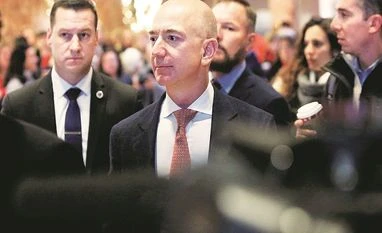
Jeff Bezos, founder, chairman and chief executive officer of Amazon.com enters Trump Tower ahead of a meeting of technology leaders with President-elect, U.S, Donald Trump in Manhattan, New York City
What is Amazon.com Inc, exactly? If you answered “an online book retailer”, then you haven’t been paying attention for like, oh, the past decade or so. What seems like a straightforward question is actually a much more complex and surprising enquiry than you might have guessed.
I began thinking about this earlier this year, when we looked at whether investors should own Amazon stock. (My answer was, it depends upon how much patience you have.) I have come to think of Amazon as a variant of Apple Inc — a disruptor of all sorts of businesses, some of which are potentially very lucrative.
What led me to this conclusion was a recent experience with a simple purchase. It dawned on me, despite having an Amazon account for almost 20 years, just how much the company has insinuated itself into so many aspects of my retail life — yours too, I’d wager.
What made me think about this was a simple purchase this past summer. I bought a couple of TVs from a local retailer, a 50-inch LG for my basement (less than $400), and a 60-inch Samsung (less than $800) for the weekend house.
Until recently, I had no idea that Amazon was part of this process from beginning to end.
First, I used a mobile app — Amazon Price Check — to compare prices. The TVs were less expensive at a local retailer by a few bucks, which the Amazon app let me know, so I bought them there. But the wall mount to hang the 50-inch (the 60-inch was going to sit on a table top) was so much cheaper at Amazon — $40 versus more than $100 — that I had to order it from Amazon. Which leads to the most interesting part of our story.
The 50-inch sat on the floor in front of the treadmill for three months. I was going to hang it myself, but you know how it goes with household chores. Once it was clear to me I was never going to get around to it, I went back to the local retailer to enquire about them hanging it for me. The quoted price was $399, about the same as the television itself; that made no sense.
I did a Google search that I expected would take me to Angie’s List or something similar. Instead, I was shocked to see something called Amazon Home Services pop up as an option. The prices were $69 for a set that was 50-inches or smaller. This wasn’t just a little cheaper: it was less than 20 per cent of the price quoted by the local retailer. I clicked, scheduled and that Friday a guy hung the television, giving me new inspiration to get on the treadmill.
He told me some interesting things: Depending upon the day, he does five to 10 installations. He does contract work for several different companies. Lastly, he has hung three sets in houses on the same block, working for three different companies — and the charges were $400, $200 and $69. He gets paid the same amount, and does the exact same work.
Now consider the potential threat this poses to Amazon’s competition. Work like this has to be a source of revenue and very likely profit for these other retailers. I have to think this kind of market inefficiency eventually will be competed away by Amazon. We’ve seen it happen before, remember. This sent me back to Amazon’s website to look at what else it offered — and it’s pretty much any local service you can imagine. It immediately dawned on me that this was a very clever business for Amazon.
Amazon isn’t spending much money on it. The company has no inventory, no financial outlay — it simply serves as a matchmaker between the consumer and service provider. Amazon takes a small percentage of each sale for its troubles. It is yet another way for the online retailer to move from physical goods into services, while monetising its enormous client base, all at very little cost.
The more I think about what Amazon actually is, the closer I come to this: It’s a self-funding incubator that ruthlessly kills the ventures that don’t work (remember the Fire mobile phone?), while pouring cash into the ones that hold promise. It’s a marketplace for new and used products, a place to hire people for services, a content company, a software maker, a gadget business, a cloud company and so on. Oh, and it’s an online retailer that just happens to be the world’s sixth-biggest company by market value — about $365 billion.
I still am not sure exactly what Amazon’s core business is or what it will end up being. I just hope it never sees an opportunity in any business I have a vested interest in.

 "Amazon is a variant of Apple Inc - a disruptor of businesses")


 Connect with us on WhatsApp