The next time you get a call checking your interest in a job opening, chances are you may be talking to a chatbot on the other side of the line. Gurgaon-headquartered PeopleStrong, a human resources (HR) technology solutions company that has been managing HR backend for several multinational Indian and foreign companies, has been using a chatbot for the past six months to assess a potential candidate’s interest in a job, run profile checks on a candidate’s suitability for a job and perform several other routine HR functions.
“We invested around Rs 50 crore in automating our recruitment assessment processes but more than recouped our costs,” says Pankaj Bansal, co-founder and chief executive officer (CEO), PeopleStrong.
Even though the firm’s top line grew by 60% over the past one year, it just had to add 50 new recruiters in 2016-17. The previous year, it had added 250 heads to maintain the same growth momentum in its top line.
PeopleStrong is one among many businesses taking this route. In January this year law firm Cyril Amarchand Mangaldas started using artificial intelligence software to analyse and extract clauses from contracts and other legal documents. The software makers claim on its website that it could save 20-90% of time spent on contract review, without sacrificing accuracy.
Last year ICICI Bank announced deployment of software robotics to take over repetitive tasks. The bank said it plans to automate up to 500 business process functions. It is not only the back end processes that are easy picking for automation and digital disruption. IT consultants say automation and digitalisation is now knocking on the doors of the finance functions in many businesses.
While automation and digitalisation brings in productivity improvement in people and process, the flip side is that jobs profiles over time get taken over by machines and software. Software major Wipro last year moved 12,000 engineers on different projects as the work they did got automated. So did Infosys with nearly 8,500 people.
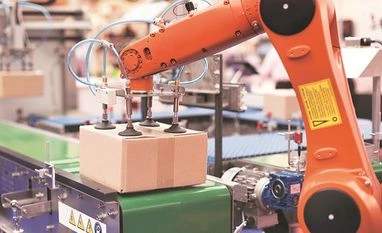
Similarly, Indian automobile sector has seen steady drop in jobs at the shop floor level with increase in automation and use of robots to reduce reliance on labour. “The kind of jobs a new car making plant will generate now could be lower by ten% compared to the plants that came up in the past,” says an industry executive.
“The jobs that are likely to feel the heat of automation the most relate to information technology (IT) and IT services, banking and financial services, back-office processing and basic customer-facing engagement services,” says Nishith Upadhyaya, head, advisory and knowledge, SHRM India, an association of HR professionals.
Low skill and high transactional jobs are more prone to getting automated. So are the transactional and processing related jobs, say HR experts.
Earlier this year, a study by McKinsey & Company said that 52% of jobs in India are automable or have the potential to be automated. That could potentially put 233 million jobs at risk, say HR experts. Similarly, a study by HfS said that India is likely to lose 640,000 jobs to IT automation by 2021.
However, without sounding alarmist, HR experts point out that this move towards automation will take place over a period of three to five years. It is not that some jobs will vanish overnight. “Some fraction of the current job profile will get eliminated with role consolidation. The key drivers of automation move will be productivity improvement,” says Moorthy K Uppaluri, managing director and CEO, Randstad India.
Automation and digitisation also mean that as some job profiles get changed and consolidated, new ones will open up, requiring different skill sets. “It is not about man versus machine. Both have to co-exist,” says Shyamal Mukherjee, chairman, PwC India. Any work that is repetitive will get automated in any industry, but it has thrown up opportunities for people to be reskilled. “Skill sets we look for include problem-solving abilities and adaptability,” says Mukherjee.
In fact, all the three major services firms – Tata Consultancy Services (TCS), Infosys and Wipro - have created a strong pool of engineers trained in digital technologies. Nearly 200,000 employees have been reskilled in digital technologies and one million certifications are done at TCS. Around 135,000 software engineers are being trained in design thinking, while 2,000 are already well-versed in machine learning at India’s second largest software exporter, Infosys.
Wipro has 61,000 employees now with digital technology skills. “In line with the growing demand for digital services, we continue to augment our workforce with digital skills,” says Abidali Neemuchwala, CEO, Wipro. The company trained 39,600 employees in FY17.
However, it is still early days for Corporate India to keep up with the changing needs of technology and the job market, say HR experts.
Next: How Indian IT is reskilling itself