Finance ministry for hands-on approach towards govt banks

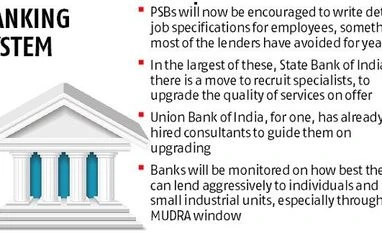
PSBs will now be encouraged to write detailed job specifications for employees, something most lenders avoided for years
PSBs, banks
.
Subhomoy Bhattacharjee
Last Updated : Oct 30 2017 | 1:56 AM IST
State-owned banks should expect more government oversight of their operations.

“It cannot be business as usual,” says a top government official.

Last week, these banks were told another Rs 2.11 lakh crore would be given to them for strengthening their capital adequacy. 

Some of the oversight will arrive as part of the ongoing wage negotiations for the sector; also, when their bosses come for detailed consultation with the finance ministry for their capital requirement rescue.

For some years the ministry has only settled the extent of a sector-wise pay raise. Leaving it to the Indian Banks’ Association, the latter’s joint forum, to fill in the details in negotiations with staff unions. It is supposed to be different this time. 

In August, as many as 11 of these banks had committed to the government that staff strength would not rise. A Bloomberg/Quint report said this was contained in a tripartite pact, drafted by SBI Capital Markets, for the banks, their employee unions and the government.

“Instead of hands-off approach, we intend to be hands-on,” said another officer, aware of the developments. According to him, other than wilful negligence, the reason why banks have got to their present state is neglect of human resources, especially in credit appraisal. 


Government banks will now be encouraged to write detailed job specifications for employees, something most of these 21 lenders have avoided for years. 

In the largest of these, State Bank of India (staff strength down to 273,000 and another 15,500 expected to leave this year), there is a move to recruit specialists, to upgrade the quality of services on offer. Union Bank of India, for one, has already hired consultants to guide them on upgrading.

The official said oversight does not mean a return to the discredited culture where North Block (finance ministry headquarters) used to lean on government-owned banks in major lending decisions. Instead, banks will be monitored on how best they can lend aggressively to individuals and small industrial units, especially through the MUDRA window. Their performance, including those of officers, will be monitored accordingly. 

For decades, government-owned banks have been accused of lending without due-diligence to companies. They, in turn, have blamed this on directions from the finance ministry. One reason for the high Rs 7.33 lakh crore of non-performing assets with these banks as of end-June (ministry data) is the surge in loans to companies from 2008 to 2012 with government encouragement. 

On the sum each bank would get from the bailout purse, an official said the list is to be disclosed soon. One of the officials Business Standard spoke to said the bonds to issued in this regard are expected to be of a 10-year tenor, an off-budget allocation. However, to keep costs low, those would not be issued by any Special Purpose Vehicle. These would be non-tradable, as the banks are expected to need it in perpetuity.

One subscription. Two world-class reads.

Already subscribed? Log in

Subscribe to read the full story →
*Subscribe to Business Standard digital and get complimentary access to The New York Times

Smart Quarterly

₹900

3 Months

₹300/Month

SAVE 25%

Smart Essential

₹2,700

1 Year

₹225/Month

SAVE 46%
*Complimentary New York Times access for the 2nd year will be given after 12 months

Super Saver

₹3,900

2 Years

₹162/Month

Subscribe

Renews automatically, cancel anytime

Here’s what’s included in our digital subscription plans

Exclusive premium stories online

  • Over 30 premium stories daily, handpicked by our editors

Complimentary Access to The New York Times

  • News, Games, Cooking, Audio, Wirecutter & The Athletic

Business Standard Epaper

  • Digital replica of our daily newspaper — with options to read, save, and share

Curated Newsletters

  • Insights on markets, finance, politics, tech, and more delivered to your inbox

Market Analysis & Investment Insights

  • In-depth market analysis & insights with access to The Smart Investor

Archives

  • Repository of articles and publications dating back to 1997

Ad-free Reading

  • Uninterrupted reading experience with no advertisements

Seamless Access Across All Devices

  • Access Business Standard across devices — mobile, tablet, or PC, via web or app

Next Story



