GST impact: Now, buy a BS-IV truck at BS-III price

Vehicle makers turn aggressive with discounts to gain sales
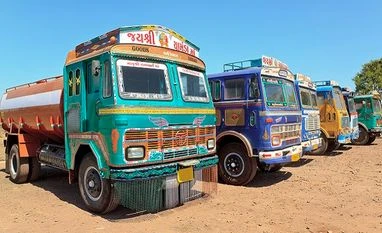
Truck
Photo: iStock
Ajay Modi New Delhi
Last Updated : Aug 19 2017 | 6:01 PM IST
Leading commercial-vehicle makers are giving steep double-digit discounts to bring back momentum in the segment, which has struggled to recover since last year’s demonetisation. 

Along with the discounts and a goods and services tax (GST)-led reduction, current selling prices of BS (Bharat Stage)-IV variant trucks are in many cases comparable to the rates for BS-III trucks.

BS-IV trucks, which emit fewer pollutants than BS-III vehicles do, were said to have the latest technology and supposed to command 5-10 per cent higher prices.

A transport firm with a national presence was out in the market to seal a deal for 25 trucks (with a capacity of 11 tonnes each) in June this year. Tata Motors is learnt to have offered this company Rs 11.10 lakh for each such BS-IV vehicle against the quoted price of Rs 13.10 lakh. 

However, the deal took place in mid-July owing to a transition to the GST. The new tax rate brought a further cut in prices and billing was done at almost 6 per cent lower at Rs 10.45 lakh. The same vehicle, which adhered to BS-III standards, used to sell at Rs 10.40 lakh until March 31.

The Supreme Court barred companies from selling BS-III vehicles from April. 

“By the time we got down to signing the deal at the final price with Tata Motors, we were approached by Ashok Leyland and the dealer offered trucks of the same capacity at Rs 10.20 lakh. But we closed the deal with the Tatas,” said an executive at the transport firm.

Dealers usually get to know of all major transactions of fleet owners since common financers work with all the brands.

Companies are admitting that high discounts are being offered. “While the discount levels in the industry continue to be the same or in some cases higher, it is not the case for Ashok Leyland vehicles,” said Vinod K Dasari, managing director, Ashok Leyland. 

Discounts are a function of the demand-supply scenario in the market. Sales of medium and heavy commercial vehicles (M&HCVs) are down 23 per cent in the first four months of FY18 to 71,223 units. The goods carrier, which forms the bulk of this segment, declined 22 per cent to 59,575 units. Light commercial vehicles (LCVs), however, grew at about 10 per cent to 139,614 units. 

Companies have pushed large stocks to dealers in July since the M&HCV segment had seen a 32 per cent decline in Q1 (first quarter), while LCVs had grown by 8 per cent. 

“Discounts have continued in the market though I cannot give a specific range. Since manufacturers need to use plant capacities, everyone is chasing bulk orders of 10 or more units from buyers,” said Vinod Agarwal, managing director and chief executive officer at Volvo Eicher Commercial Vehicles. 

An industry executive said no manufacturer would admit that it was giving these kinds of discounts but the reality is different. 

Dasari said the company had not and would not chase market share by giving higher discounts or under-pricing. “Our increase in market share along with profitability is proof of that.”

A spokesperson for Tata Motors, the country’s largest commercial vehicle player, said the company only passed on GST benefits to customers. “Over the past three months, the company has seen a strong revival in volumes month after month as the ramp-up in the production of BS-IV vehicles continued and the vehicle demand has increased in the market across various segments,” the spokesperson added. Industry watchers question the growth reported by companies in July dispatches to dealers. 

S P Singh, senior fellow at the Indian Foundation of Transport Research and Training, said the economic indicators did not point to any increase in demand for commercial vehicles.

“The demand being projected is superfluous. Manufacturers have pushed higher stocks to dealers in July and now dealers are struggling to close deals,” he said.

Singh also said confidence in BS-IV vehicles was not high, especially among small operators. It is understood that mechanics at roadside garages are not comfortable addressing issues that crop up in these vehicles. Consequently, such small operators are opting to buy four-five-year-old BS-III vehicles, which have a national permit of 15 years.


One subscription. Two world-class reads.

Already subscribed? Log in

Subscribe to read the full story →
*Subscribe to Business Standard digital and get complimentary access to The New York Times

Smart Quarterly

₹900

3 Months

₹300/Month

SAVE 25%

Smart Essential

₹2,700

1 Year

₹225/Month

SAVE 46%
*Complimentary New York Times access for the 2nd year will be given after 12 months

Super Saver

₹3,900

2 Years

₹162/Month

Subscribe

Renews automatically, cancel anytime

Here’s what’s included in our digital subscription plans

Exclusive premium stories online

  • Over 30 premium stories daily, handpicked by our editors

Complimentary Access to The New York Times

  • News, Games, Cooking, Audio, Wirecutter & The Athletic

Business Standard Epaper

  • Digital replica of our daily newspaper — with options to read, save, and share

Curated Newsletters

  • Insights on markets, finance, politics, tech, and more delivered to your inbox

Market Analysis & Investment Insights

  • In-depth market analysis & insights with access to The Smart Investor

Archives

  • Repository of articles and publications dating back to 1997

Ad-free Reading

  • Uninterrupted reading experience with no advertisements

Seamless Access Across All Devices

  • Access Business Standard across devices — mobile, tablet, or PC, via web or app

Next Story


