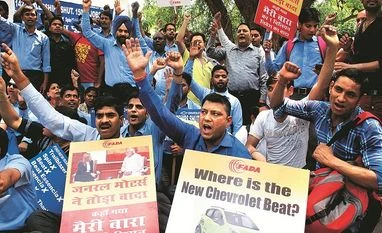
The recent announcement by General Motors India to stop selling cars in the domestic market by the year-end has met with strident protests from its dealers. Given the scenario, the company has to avert the possibility of a messy exit by building consensus among all stakeholders.
A GM India spokesperson says the company’s decision to withdraw from domestic sales was based on its global business strategy. “GM is focused on strengthening our core business and investing to lead the future of personal mobility. This requires the company to take decisions on where we deploy our shareholders’ capital. If we don’t see a clear path to market leadership and long-term sustained profits, we will continue to look at opportunities to focus our resources on areas that will lead to the greatest results.” The American auto giant has been present in India for over two decades, but its brands never took off as it ran mounting losses and ended with a measly market share of 0.85 per cent in 2016-17.
A majority of GM India’s 96 dealers, operating around 140 showrooms across the country, was opposed to the offer of around 12 per cent of their investments as compensation. Asked about the dealers’ allegations of inadequate compensation and demand seeking government intervention to prevent job losses, the spokesperson says, “We are providing our dealer partners a fair and transparent transition assistance package based on a methodology that is consistent across all dealers. The methodology is then applied to the individual circumstances of each dealership. The discussions with individual dealers are confidential.”
Jones Mathew, professor, marketing, Great Lakes Institute of Management, lists factors that an organisation exiting a country like India should consider. These are — the economic impact of loss of jobs, social impact of an anti-American attitude toward brands exiting without adequate warning, transparent communication with stakeholders, fair compensation to channel partners, retraining and replacement of affected workers to reduce negative effects, proper evaluation of take-profit or stop-loss decision, and political and trade union support for exit decision.
According to Mathew, the most important but often overlooked step is communication, trust building, and transparency through the entire exit process. “Given the magnitude of the decision, GM could have gone about the exit process in a more transparent and equitable manner,” he says, adding that dealers must be compensated with at least 25-50 per cent of their investments in the brand.
Abdul Majeed, partner at PwC India, says a company has to devote substantial time, extending to over a year, to address concerns of all stakeholders — buyers, dealers and the government — before exiting a market. “You may not be able to pay everything that dealers are asking for but you have to come to a consensus at least. Sufficient time for planning, so that you can take stakeholders into confidence, is the key.” Suppliers and employees are especially critical, and therefore the company has to make sure its decision does not impact them.
Even as GM plans to halt domestic sales in India, its joint venture partner Shanghai Automotive Industry Corporation of China (SAIC) is set to enter the country with its brand Morris Garages and likely start operations in 2019. There is a possibility of GM selling a manufacturing plant in Gujarat to SAIC. Majeed says if a new company takes over, the outgoing firm can work out modalities to minimise the effects of its exit.
“Even if you are selling assets to someone else, at least it would ensure continuity for some stakeholders,” he says, adding an example of South Korean auto company Daewoo Motors which had incidentally sold off its assets to GM.
Siddharth Shekhar Singh, associate professor of marketing at the Indian School of Business, stresses that a company has to exit in a manner that its brand reputation is not damaged. “Wrong steps at the exit stage would make re-entry all the more difficult even if the conditions are right,” he adds.
For a SAFE departure
- A company exiting a market must devote substantial time to address concerns of all stakeholders — buyers, dealers and the government. Building consensus is an important goal
- If a new company takes over assets, the outgoing firm can work out modalities to minimise adverse effects
- Since GM is producing vehicles for export, it can buy back inventory from dealers, if possible, to cut losses, or compensate them in some other way
Singh argues that GM has not dealt with its dealers and customers too well, although it seems to have handled the issue of compensation to its employees better. “This is not a pleasant situation and there will be losses for all. How fair, caring and stakeholder-friendly GM comes across would decide the effect on its brand in India and subsequently impact prospects on re-entry, if any.”
GM India says it has prioritised a stable and smooth transition for its customers, employees and business partners. “We will maintain a service network across key locations in India, as well as continuing to honour Chevrolet vehicle warranties; provide support through Chevrolet’s roadside assistance, and spare parts to support maintenance and repair,” the spokesperson adds. GM India exports the Chevrolet Beat hatchback and sedan to a number of left-hand-drive markets in Latin America. It recently announced regular shipment of the sedan version of Chevrolet Beat to Latin America. “We have a robust export outlook that supports continued manufacturing at our Talegaon plant and further leveraging of our local supply base,” the spokesperson says.
Singh also feels GM erred in not giving enough of a lead time to all stakeholders to warm to its decision and thereby reduce risks to its brand reputation. “Since it is producing vehicles in India for export, it can buy back the inventory from dealers, if possible, to reduce losses, or compensate them in some other manner. Further, it should enhance the payment to them to cover losses. Regarding customers, GM should not only ensure that the service centres are open and functioning smoothly, but also publicise the same to remove apprehensions.”

 "How General Motors can reduce exit pain")












 Connect with us on WhatsApp