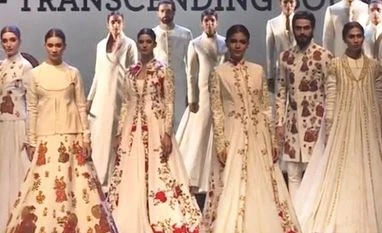
Copy our designs and we will take you to court: The message is loud, clear and long overdue. And it is coming from some of India’s top couturiers who have for years suffered loss of revenue and a hit to their brand value because of their designs being brazenly and rampantly plagiarised.
Rather than let such instances slide – as they would ordinarily do in the past – designers such as brothers Shantanu and Nikhil Mehra of the label Shantnu & Nikhil, and Gaurav Gupta now have either in-house legal teams or are turning to lawyers to arrest the menace. Some, like Sabyasachi Mukherjee and Anita Dongre, have gone to court successfully.
Others, like the couturiers behind the label Rohit Gandhi & Rahul Khanna, too are proactively taking on those who imitate their creations. “A leading menswear brand had, for instance, copied a few of our designs from a newly launched series, and we took legal steps to stop them,” says Khanna. They also flagged the matter when a high-profile international socialite wore one such alleged counterfeit and have been contesting the case legally with its seller.
The designers weren’t always this zealous in dealing with rip-offs.
“There used to be a significant lack of awareness in the design community. Many of them would either not protect their designs at all or would ask for protection after the commercial success of a launch,” says New Delhi-based copyright lawyer Safir Anand, who is a senior partner at law firm Anand and Anand.
Things are, however, beginning to change.
“We now have a legal team to tackle this huge market (of counterfeits),” says Manish Malhotra, who has for years dressed some of Bollywood’s most glamorous women. “With swift research on social media platforms, we’re able to track down these sellers, vendors, and third parties. We message them with a notice or a warning, and they (invariably) change their communication to ‘inspired by Manish Malhotra’ or ‘copy of Manish Malhotra’, which of course downsizes their credit.”
Khanna adds they, too, take plagiarism quite seriously and understand that apparel designs can be protected through both copyright and designs law. “We are advised by our lawyers to take some measures such as date stamping all our original illustrations,” he says.
The laws, says Anand, are well-drafted in the sense that designers have provisions under the Designs Act, 2000, which enables them to protect their creative work before they are launched. “It is almost like a claim to priority because once the designs are out there, it can become contentious to show who came first.”
There is also the copyright law, which allows designers to protect their drawings, photographs, lookbooks etc. This, says Anand, is becoming increasingly important in the age of social media.
There’s also scope for protection under the Trade Marks Act, 1999, “where not only titles, but certain elements of a look itself have become a trademark — like the Birkin bag or the Burberry check,” says the lawyer.
Several Indian brands like Jockey India, Action footwear and Shahnaz Husain cosmetics use holograms and unique codes to authenticate their products. Historically, couturier Charles Frederick Worth would sew his name on his gowns.
Over the years, the law has been amended to also cover intermediary liability. “If there’s a violation of a product on an e-commerce platform such as Amazon or IndiaMART, even they become liable to pull it down.”
Limits to protection
While the designer community is becoming more active towards protecting its interest, the legal process remains tedious and has limitations.
Take the case of Mumbai-based designer Payal Khandwala. Khandwala became a victim of plagiarism when in 2019 a Surat-based wholesaler copied her handwoven reversible saris from her collection titled Gemini. She sent him a legal notice but settled for an apology and a retraction of the collection rather than fight a long battle for damages.
“We have tried sending legal notices, but a lot of the time all one gets is a blasé apology, which seems like a band-aid approach. In the end, we have to just move on,” she says.
Khandwala explains the complications: “If someone steals my copyrighted design, which has, say, four pockets, and makes it with two pockets instead, it will still be a copy but it will be different enough for it to pass. Or, if it is recreated in a different colour, that can pass too.”
Khanna draws attention to another issue: if a design is reproduced more than 50 times by an industrial process, copyright protection to it is terminated right away. So, the designers’ legal teams advise them to create less than 50 editions of a design.
Also, registering designs under the designs law can be a long and expensive process. Moreover, after 15 years, the designs come in the public domain and hence obtaining design registration might not be a good idea in every case, Khanna says.
Couturiers feel more can be done. “Our lawyers have proposed that trade associations seek amendment in the law, particularly the provision under the Copyright Act that grants protection only until the design is not reproduced more than 50 times through an industrial process,” says Khanna. “This is clearly an embargo on our right to monetise from our original designs, which might also remain relevant after 15 years.”
He adds, “Perhaps a body on the lines of the Fashion Design Council of India, but one that’s focused on protecting the legal rights of the design community, is in order.”
Business of fakes
Trade in fake goods is now almost 3.3 per cent of world trade, according to a 2019 report by the Organisation for Economic Co-operation and Development and the EU's Intellectual Property Office. Among the top ten sectors where this problem is severe are footwear, clothing, leather goods, watches and jewellery, says Chander Shekhar Jeena, secretary, Authentication Solution Providers' Association (ASPA).
Fake footwear accounts for 22 per cent of the total global counterfeit market; clothing forms nearly 16 per cent; and leather goods make for 12 per cent, Jeena adds.
These numbers have prompted several retail brands to start using authentication solutions.