Indian promoters' stake in companies at 8-year low
Promoters' holding in private sector BSE 500 companies declined to 43.4% in Sept
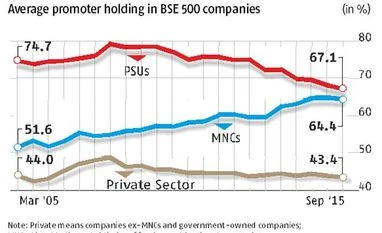
Krishna Kant Mumbai Are Indian promoters less bullish about their companies than their foreign peers or institutional investors? There has been a steady decline in promoters' holding in Indian private sector companies to an eight-year low of 43.4 per cent at the end of September 2015. The corresponding ratio was 44.4 per cent a year ago and 48.7 per cent at its peak in the March 2008 quarter.
A similar trend is visible in the public sector undertakings (PSUs) with a consistent decline in promoters' (government) holding as the government pursues divestment. Effective promoter holding in PSUs is down nearly 750 basis points or around 10 per cent in the past decade to 67.1 per cent at the end of the last quarter from an average holding of around 75 per cent in 2005.
In comparison, foreign multinationals have been consistent buyers on Dalal Street shoring up stakes in their Indian arms. Promoter holding in listed foreign companies such as Hindustan Unilever, Bosch, ACC, Ambuja Cement and Nestle India, among others, is up to a high of 64.4 per cent at the end of the September 2015 quarter from a low of 51.6 per cent in March 2005.
At the end of September 2015, Indian (private) promoters' holding in their companies was worth Rs 28.5 lakh crore (Rs $438 billion), up from Rs 26.7 lakh crore in September 2014 and Rs 3.4 lakh crore in March 2005. In comparison, global companies' stake in their Indian ventures stood at Rs 6.8 lakh crore (Rs $104 billion), while the government's stake in listed public sector companies was worth Rs 11.1 lakh crore (Rs 170 billion) in September 2015, respectively.
Analysts attribute the reduction in stake of domestic promoters to the capital constraints faced by many domestic companies and business group for funding their various growth projects. "Most Indian companies and business groups have expanded aggressively in the past decade and equity dilution has been a preferred and low-cost option for companies to raise fresh capital. This has been especially true in capital hungry businesses such as banking, financial services and infrastructure," says Nitin Jain, head (equity markets) at Edelweiss Capital. The analysis is based on the quarter ending shareholding pattern and market capitalisation of 476 BSE 500 companies whose latest shareholding pattern is available. Effective ownership is based on the market value of the shareholding of each class of investors/owners.
In many cases, where the stake has come down, companies have been forced by the market to raise fresh equity by diluting promoters' stake. For example, there was a flurry of equity issuances by capital-starved companies such as GMR Infra, Jaypee Associates and Reliance Communications in 2014. The funds were raised through qualified institutional placement of fresh shares, leading to a corresponding decline in promoters' holding in the companies.
Experts say some promoters behave like financial investors and tend to time the market. "Promoters tend to offload shares either to book some profit or raise fresh capital during bull-runs and increase their stake when valuations plummet when markets fall," says Dhananjay Sinha, head (institutional equity) at Emkay Global Financial Services.
There is an element of truth in this. Promoter stake was up during the 2011 and 2013 market correction, but resumed the downward trajectory in the bull run that started in the latter half of 2013.
Indian promoters sold their stake to foreign portfolio investors and domestic institutions such as insurance companies and mutual funds. Domestic retail investors, too, joined the buy-trade in the past two years reversing the earlier trend when retail money, including high-net worth investors, were net sellers for about a decade.
Multinationals that largely stick to their original line of business restricting their need for fresh capital have seen no equity dilution. On the other hand, many foreign companies have raised their stake in their Indian subsidiaries as return on equity is higher in India than the cost of capital in their home markets of Europe and North America. For example, Unilever raised capital for less than one per cent in the US and used the proceeds to raise stake in Hindustan Unilever in 2013, which offers earnings yield of three per cent.

 "Indian promoters' stake in companies at 8-year low")

