Jindal coal bid case: Govt report found no proof of cartelisation
Officials say govt has not received fair value for its mine in the bid and there is evidence to prove that
Shreya Jai New Delhi Even as the Naveen Jindal-promoted Jindal Steel and Power Ltd (JSPL) has approached the Delhi high court against the rejection of its bid in the recent coal e-auction, the coal ministry’s bid evaluation report — part of the government’s submission in the court — seems to suggest there is no evidence of cartelisation.
“There is no conclusive proof indicating any collusive bidding, nor any complaint received about the e-auction platform obstructing bidders from submission of bids,” says the report, which has been reviewed by Business Standard.
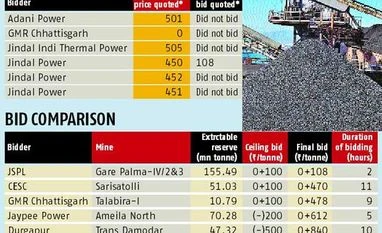
In the evaluation report, the nominated authority of the coal auctions has compared the duration of bidding, ceiling price based on initial price offer, closing bid and name of the closing bidder for the coal blocks kept for end-use power generation.
The report also observes that arbitrary bids were received from other bidders, apart from Jindal, for Gare Palma-IV/2&3 coal blocks. “The government was never of the view that there was any cartelisation of any sort; so, the petitioner’s plea is untenable. Our argument is that we didn’t receive the fair value for the mine and there is reasonable evidence for that,” said a senior official in the know.
The coal ministry did not give a vesting order to the JSPL-promoted Jindal Power on March 20, citing “comparatively low bids”. The next day, JSPL moved court, challenging the government decision. The court, in its observation last week, said there was no case of cartelisation in the bidding.
“The government can definitely question the bids if it has a strong proof of bid price rigging or mala fide by the participants. But there is nothing in law that allows a body with discretionary powers to cancel a bid by just calling it low. We have to see what proof the coal ministry has,” said a lawyer with a leading law firm with expertise in the energy sector.
The government officials looking into the matter said the bid quoted by Jindal was starkly low. “If not us, then some other private company would have noticed and then questioned the bid. Our contention is when there was aggressive bidding for all coal blocks for the power sector, then how come this bid closed in two hours and at such a low price,” asked a senior government official.
The report has highlighted that Adani Power quoted the opening bid for Gare Palma-IV/2&3 and then pulled out. It also questioned the zero bid put up by GMR, which then did not bid further. GMR went on to win Talabira-I in Odisha for a much higher Rs 478 per tonne in bidding that ran for 10 hours. Adani Power won the non-operational coal block Jitpur, earlier owned by Jindal Power in Jharkhand, for Rs 302 per tonne during the second phase of auction.
Of all the mines put up for auction, Gare Palma-IV/2&3 is the richest coal block with 155 million tonnes of extractable reserves and received the lowest bid in the two phases of auction running from February 14 to March 8.
Of the 34 coal blocks auctioned in two phases, the letters of allocation for three blocks — two of Jindal and one of Balco — were not signed, after review of eight low bids. JSPL has bid the lowest in both the phases for end-use power. Balco, on the other hand, was the lowest bidder in the unregulated category.
First phase of auctions saw operational 21 coal mines put up for auction, whereas the second phase was for 19 about-to-produce mines - from February 14 to March 10. For the power sector, there was reverse bidding and for unregulated, there was forward bidding - the highest bidder won the block.
First phase of auctions saw operational 21 coal mines put up for auction, whereas the second phase was for 19 about-to-produce mines - from February 14 to March 10. For the power sector, there was reverse bidding and for unregulated, there was forward bidding - the highest bidder won the block.

 "Jindal coal bid case: Govt report found no proof of cartelisation")


