Leadership trouble at Infosys: No country for global talent!

From Rajan to Panagariya's departure, we failed to offer runways to international talent to thrive
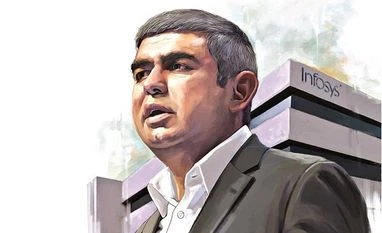
Vishal Sikka. Illustrations Ajay Mohanty
S 'Venky' Venkatesh
Last Updated : Aug 21 2017 | 3:47 PM IST
One of the primary sources of conflict in literature is the clash of values and ideology between the old and new, the traditional and modern. In Shakespeare’s plays there is conflict between generations and ideologies; class conflict; racial conflict; and at the heart of it all, the conflict between light and darkness. Many of these are layered in what is perhaps his greatest tragedy King Lear. Moving beyond the personal, Shakespeare offers the more universal generational conflict. But it goes deeper — King Lear is a Renaissance play when the old world had become dated and defunct and a new spirit was sweeping through Europe.

Seventy years after independence, India stands at the juncture of being one of the fastest growing economies in the world, while simultaneously being mired in the grime of religious bigotry, women's safety, caste tensions and superstition. Across corporates, politics and public institutions, never before has the clash between the old and the new been more obvious. The unfortunate saga currently unfolding at Infosys is just a case in point. While one can examine a host of reasons that lead to such leadership crises, I examine this incident from the lens of attracting global talent and the subsequent conflicts that often arise.

The “drum beat of distractions and negativity” that Vishal Sikka refers to in his resignation letter includes the controversy surrounding allegations of poor corporate governance, as well as criticism around acquisitions and executive pay. From a purely HR perspective, it is routine (and logical) for CEO compensation to be linked to market benchmarks for the role and performance. Sikka’s pay was no exception. All such compensation decisions for CEO are signed off by the remuneration committee and the board. Therefore, any murmur after such closure is definitely in poor taste. In this case, Murthy’s statements on executive compensation are also in line with the entire posturing around the repudiation of private wealth and tokenism of frugality that is so applauded in India. Why do we resent those who earn their money legally?

The issue of “cultural” conflict is also acute in Indian companies which look towards attracting global talent. While the old loyalists and members of the founding team are often aware of the need for reenergising flagging lines of business, the ability to sever the umbilical cord and embrace the new, is largely reluctant and excruciating. In this regard, it’s noteworthy that while Sikka was brought in not just to take over the CEO role, but to reposition Infosys beyond plain vanilla services. The company needed Sikka to leverage his global technology expertise at a product major like SAP. By focussing on newer technologies, artificial intelligence, etc, Sikka would have ended up freeing the Infy workforce to provide more specialised services higher up in the value chain.

However, stories of such sudden departures are hardly new in India — one recalls the abrupt exit of Wipro’s Vivek Paul. More recently, one is reading media reports about Tata group Chairman N Chandrasekaran reversing many of the decisions taken by the Tata Motors CEO Guenter Butschek, including Butschek’s bold move to de-layer the traditional Tata Motors organisation. Will this result in yet another global CEO to depart from India? I sincerely hope not.

Today, India’s political landscape lies barren without a credible Opposition; the nation’s grand old party has been decimated by the same system that only seeks to recognise and crown its own without looking for suitable candidates outside. Succession planning and infusion of fresh talent from outside seems to be a challenge across organisations in India — corporate or political.

From the controversial departure of Raghuram Rajan to the recent news about the head of the Niti Aayog, we have failed to offer runways to international talent to thrive and soar. Other than MNCs bringing in expat talent to head India Operations, there are hardly any noteworthy examples of expat CEOs who have worked for a considerable period of time in Indian companies. It is time we realise that in all of this, we have been left the poorer and we are in clear danger of being perceived as a country which simply does not know to attract and retain global talent.

The author is President-HR and management board member, RPG Enterprises

(The views and opinions expressed in this article are those of the author and do not reflect those of the organisation)

One subscription. Two world-class reads.

Already subscribed? Log in

Subscribe to read the full story →
*Subscribe to Business Standard digital and get complimentary access to The New York Times

Smart Quarterly

₹900

3 Months

₹300/Month

SAVE 25%

Smart Essential

₹2,700

1 Year

₹225/Month

SAVE 46%
*Complimentary New York Times access for the 2nd year will be given after 12 months

Super Saver

₹3,900

2 Years

₹162/Month

Subscribe

Renews automatically, cancel anytime

Here’s what’s included in our digital subscription plans

Exclusive premium stories online

  • Over 30 premium stories daily, handpicked by our editors

Complimentary Access to The New York Times

  • News, Games, Cooking, Audio, Wirecutter & The Athletic

Business Standard Epaper

  • Digital replica of our daily newspaper — with options to read, save, and share

Curated Newsletters

  • Insights on markets, finance, politics, tech, and more delivered to your inbox

Market Analysis & Investment Insights

  • In-depth market analysis & insights with access to The Smart Investor

Archives

  • Repository of articles and publications dating back to 1997

Ad-free Reading

  • Uninterrupted reading experience with no advertisements

Seamless Access Across All Devices

  • Access Business Standard across devices — mobile, tablet, or PC, via web or app

Next Story


