Hillary John Uche's Diamond Ark boutique in Arjun Nagar
“Everything in this shop, including the haircut, costs Rs 100,” he informs, pointing to a shelf that showcases used plastic bottles full of chin chin, a Nigerian deep-fried snack made from flour, sugar, butter and eggs. On a settee, two men are waiting their turn for a haircut. “So, is staring part of your culture? Why does everyone stare at us wherever we go?” asks the younger of the two men. But others have greater things to worry about. “The other day, somebody in the neighbourhood dropped an egg on my friend’s head,” complains the other, a strapping man who goes by the name of CJ. The barber now takes a moment off to point to a full-length poster showing African hairstyles that has been crudely taped on the shopfront. “This shop was vandalised one night by a group of locals. The police did come but they couldn’t find out who the culprit was,” he says.
It’s easier for those working at the barbershop to openly voice their concerns; this little-known temporary utilitarian structure will run as long as its owner doesn’t draw the attention of immigration authorities. But those who have spent a fair amount of money on their businesses are careful not to spill out their troubles. It is, after all, not easy for a Nigerian to set up shop in India. Recently, Nigeria’s high commissioner to India, Ndubuisi Vitus Amaku, complained that Nigerian nationals were not being allowed to set up small businesses in India. “Nigerians living here are even unable to open an account, so how can they start a business,” he was reported as saying.
Much of this has to do with the alleged involvement of Nigerians in organised crime across the country. According to the Nigerian High Commission, more than 500 Nigerians are lodged in various jails across India, including in Delhi. “There are at least 125 Nigerian nationals in Tihar jail, of which 10-12 are women [the jail has 13,000 inmates]. Most of them came to India on tourist visas. Ninety per cent of the cases involving Nigerians are related to drug trafficking and the rest include cyber scams, credit card fraud et cetera,” says Sunil Kumar Gupta, the jail’s law officer. According to jail authorities, a considerable number of Nigerians end up in jail for overstaying their visas.
Gupta discloses that exporting clothes and other items from India may sometimes be used as a front for drug trafficking; other times, it’s purely business. Clothes bought for Rs 300-500 apiece from apparel- manufacturing units in Tirupur and Coimbatore sell for as much as Rs 1,800-2,000 across Nigeria. But some have gone a step further and put their entrepreneurial skills to good use. This is evident in the many African hair salons that have sprung up in several parts of Delhi.
“India is not a bad country. You must know how to conduct yourself,” says Destiny Achonam, a 26-year-old Nigerian national who works at Nija Barber’s Shop. The salon is owned by Antony Nweke, a Nigerian national who set up shop in January 2013 at Arjun Nagar, a teeming Punjabi neighbourhood of narrow lanes in posh Safdarjung Enclave. The glass-fronted salon, painted black, white and red, is small but chic. Its clients are fashion-conscious Africans who have a hard time maintaining their hair in India.
Unfamiliarity with Afro-textured, coil-prone hair makes it difficult for Indian salons to style their hair. The five hairdressers at the shop, which mostly caters to men, do their clients’ hair in a number of ways, the two most popular of which are the Gallas cut (which is a variant of the Mohawk hairstyle worn by French footballer William Gallas) and Bob Marley dreadlocks. Apart from African clients, who number 25-30 on weekends, the salon is frequented by Indian women, who pay Rs 500 to have their hair braided.
If the desire to stay stylish has spawned a small but growing number of African hair salons, the lack of home-grown food and a longing to savour every mouthful of it, away from the intrusive gaze of the multitude, have also created opportunities for business — on the sly, of course.
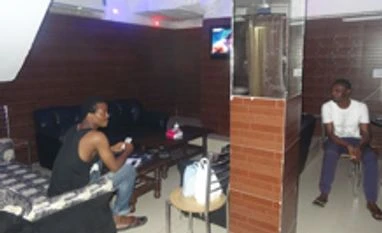
Down an uninviting backstreet in south Delhi’s Krishna Nagar, the basement of a residential building is guarded by a black barred gate. The gate opens to a large, dim-lit, squeaky-clean room that has lounge-like character, with chestnut walls, huge black couches, an LCD television, and strobe lights. This is an “African kitchen”, one of the many such informal eateries that nestle quietly in small apartments, bear no shop signs, and are frequented by Africans who want to eat, drink and make merry. This one is run by Jack Ogbonna, a brawny 30-year-old Nigerian. The place opened just two weeks ago, after Ogbonna rented a fixer-upper for Rs 17,000 a month and renovated it. The kitchen serves, among other things, Nigerian goat meat pepper soap, smoked crayfish, and plantain cooked in palm oil. Most of the ingredients have been sourced from Delhi’s INA market, a food mart that increasingly stocks Nigerian foodstuffs and cosmetics.
“We want a place we can call our own. This is where any African can walk in and feel at home,” Ogbonna says. On the music player, a track by a South Indian artist is playing to reggae beats. “I got this song from my Indian neighbours, and remixed it. It’s a good mashup,” Ogbonna says, even as he points out that the only Indians to visit this kitchen are from northeast India. It is not uncommon for African men in India to strike up a friendship with women from the northeast. A shared sense of exclusion and similarities of religion help bring the two communities closer.
Like George Christopher and his Mizo wife. A few chat sessions on Yahoo messenger across two different continents brought the two closer. The cyber friends finally got married in 2009, when Christopher came down to Mizoram. His marriage to an Indian woman also made it possible for Christopher to gain an X (entry) visa, which is available to a foreign national married to an Indian citizen and can be extended on a year-to-year basis for a period of five years. They have two children, a daughter and a son. “In 2015, I’ll take my family to Nigeria for the first time,” he says. Not far from Nija Barber’s Shop in Arjun Nagar is Manny’s Square. This humble diner, owned by Christopher’s wife and run by him, has been serving Nigerian food since 2010. Inside, the rules are taped on the wall: “No fighting or settling any issues here.”
Most African businesses in India have come up primarily to serve their compatriots. But Diamond Ark is not one of them. “I want to be recognised as a Nigerian-born Indian designer,” says Hillary John Uche, who runs the boutique in Arjun Nagar. The 32-year-old from Nigeria’s Anambra state grew fond of India’s diverse textile tradition while on holiday in 2007. In 2010, Uche, whose mother is a well-known seamstress, returned to India, studied fashion design at JD Institute of Fashion Technology in Delhi, won the Best International Student award, and launched Diamond Ark in September 2012.
It is an unpretentious store packed wall to wall, rack to rack, with evening gowns, dinner jackets, shirts, neck ties and bow ties with polka dots and stripes. Uche insists that his clothes are for everybody, not just Nigerians. But he does like to throw in a dash of Nigerian style once in a while. That is when he designs a salwar kameez, a ruffled evening dress, or even a three-piece suit entirely on Ankara, a cotton fabric with vibrant motifs once regarded as the clothing of the less-privileged in Africa. “I plan to spend at least the next 50 years in India,” says Uche. “I look at my colour as an advantage. It announces my presence, and helps me get noticed.”
[Some names have been changed on request]

 "Lives and businesses of Africans in Delhi")


